Main » Uncategorized » Miniature intraoral robot: micrometer precision and reconceptualization of preparation paradigm
Miniature intraoral robot: micrometer precision and reconceptualization of preparation paradigm
Swiss researchers have developed a prototype robot that could fundamentally change the predictability and precision of tooth preparation. In an interview with Dental Tribune International, Professor Ronald Jung from the University of Zurich discusses the clinical potential of the device and the technical obstacles to its implementation in practice.
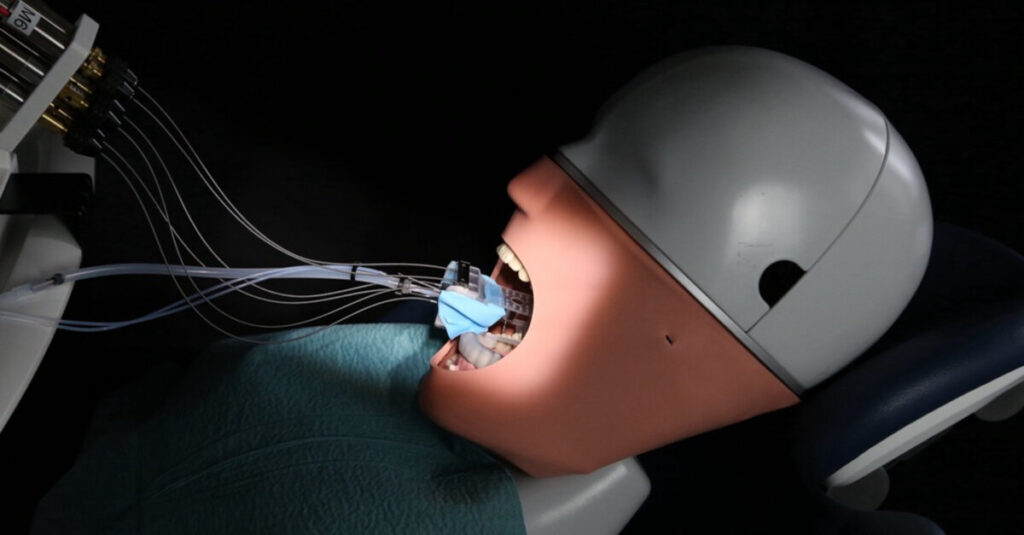
The device, named MIR (miniature intra-oral robot), was developed in collaboration between the universities of Zurich, Basel, and Bern with support from the Swiss Innovation Agency. The key feature of the design is that the robot is attached directly to the patient’s teeth and moves together with the jaw, eliminating the need for constant position correction during head movements.
Clinical potential in restorative dentistry
According to Prof. Jung, the greatest value of the system lies in the transformation of the entire restorative treatment cycle, not just in the preparation itself. The system enables a highly personalized approach, removing only the tooth structure specified in the digital plan. Unlike manual preparation, where the volume of removed tissue depends on the clinician’s experience and visual assessment, the robot provides reproducibility of the procedure.
The anticipated benefits include: reduction of procedure invasiveness; the ability to assess the definitive restoration before preparation begins; reduction in the number of appointments and the total time the patient spends in the chair.
Engineering challenges in device development
Compactness was the primary requirement: in the molar region, the oral opening can be only 16–17 mm. Prof. Jung’s team conducted a clinical study, measuring the oral opening in 100 patients to determine the maximum dimensions of the device. The motors are placed outside the oral cavity and connected to the working section through flexible shafts.
The prototype demonstrated preparation accuracy in the micrometer range. However, the current version does not include real-time sensors for automatic correction of positioning errors, so direct comparison with manual preparation is not yet possible.
Directions for technology development and application
The next generation will focus on increasing mechanical stability, integrating position sensors and feedback systems. Implementation of an intelligent bite block is planned to ensure reproducible robot positioning relative to the tooth. The developers emphasize that the robot is viewed not as a replacement for the dentist, but as an assistant for performing standardized preparation procedures under the dentist’s control.
In the future, the technological platform could be adapted for various fields: implantology; minimally invasive caries removal; endodontic access preparation. The research was published in IEEE Transactions on Medical Robotics and Bionics (May 2026).
Variability in the interpretation of dental radiographs between clinicians remains a significant problem, and research documents low detection rates for
We use cookies to improve website performance, analyze traffic, and personalize content. You can accept all cookies or customize their use. Learn more in our Cookie Policy.
Functional
Always active
Technical storage or access is strictly necessary for the legitimate purpose of making possible the use of a particular service expressly requested by the subscriber or user, or solely for the purpose of carrying out the transmission of a message over an electronic communications network.
Preferences
The technical storage or access is necessary for the legitimate purpose of storing preferences that are not requested by the subscriber or user.
Statistics
Technical storage or access used solely for statistical purposes.The technical storage or access that is used exclusively for anonymous statistical purposes. Without a subpoena, voluntary compliance on the part of your Internet Service Provider, or additional records from a third party, information stored or retrieved for this purpose alone cannot usually be used to identify you.
Marketing
Technical storage or access is necessary to create user profiles for the purpose of sending advertising or to track a user across a website or multiple websites for similar marketing purposes.