Main » Technologies » Voice artificial intelligence in dentistry: documentation automation
Voice artificial intelligence in dentistry: documentation automation
Modern dentistry is increasingly facing a paradox: the growth of technological sophistication in clinics is accompanied by an increase in the administrative burden on the physician. Despite digitalization, clinical documentation remains a labor‑intensive stage that interrupts the treatment process, requiring either an assistant’s involvement or constant switching of the specialist’s attention. In these conditions, the development of voice AI solutions is becoming one of the most promising areas for optimizing clinical practice.
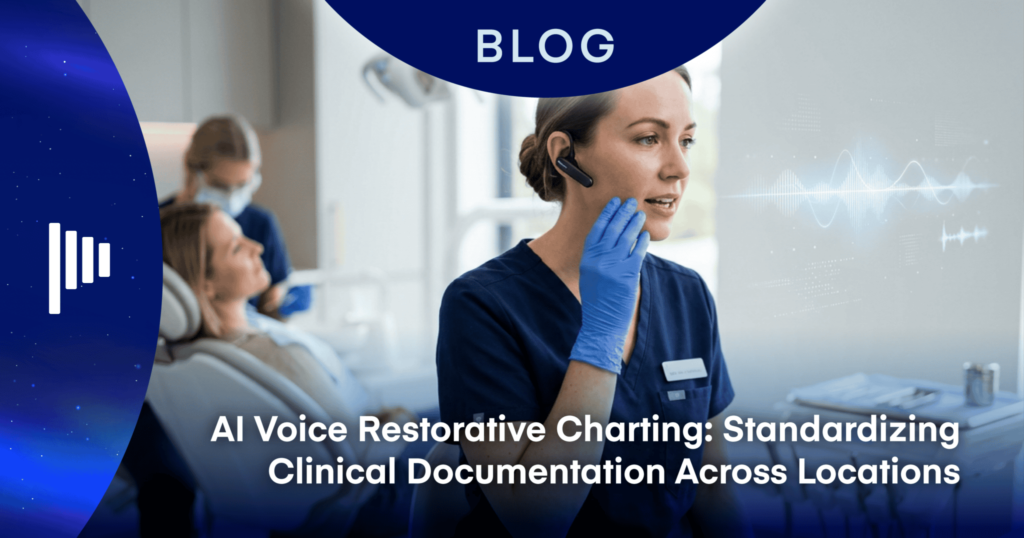
The Planet DDS publication on AI Voice Restorative Charting technology demonstrates how voice artificial intelligence is beginning to transform one of the most burdensome segments of dental work — restorative charting.
The problem of clinical documentation as a systemic constraint
Restorative charting is traditionally one of the most resource‑intensive procedures in dentistry, as it involves recording caries, existing restorations, cracks, and treatment plan elements. In the classic model, this process requires either the participation of a second specialist acting as a “scribe” or constant distraction of the physician for data entry, which disrupts the flow of the appointment and reduces focus on the patient.
This model not only increases appointment duration but also creates variability in data due to individual physician habits and differences in documentation approaches. In the context of scaling clinics and network organizations, this leads to problems with data comparability, complicates auditing, and reduces the manageability of clinical processes.
Technological foundation: integration of voice and practice management system
The solution implemented within the Denticon platform is based on the principle of deep integration of voice input directly into the practice management system. Unlike traditional dictation tools that function as external add‑ons, AI Voice Restorative Charting operates within the core infrastructure, ensuring direct recording of data into the patient’s clinical record.
The system recognizes specialized dental terminology, including abbreviations and complex commands, interpreting the physician’s speech in real time. At the same time, the visual interface displays the entered data directly during the appointment, and voice commands allow for instant adjustments without using a keyboard. Thus, a new model of interaction with the information system is formed, in which voice becomes the primary interface for managing clinical data.
Single‑physician workflow model: eliminating support staff
One of the key outcomes of implementing voice AI is the ability to transition to a single‑physician documentation model. The technology allows the specialist to independently record clinical data during the examination, eliminating the need for an assistant performing scribe functions.
This is of fundamental importance for clinic efficiency, as it reduces dependence on human resources, simplifies appointment organization, and allows for more flexible staff management. At the same time, the number of interruptions associated with switching between treatment and documentation is reduced, which improves the quality of patient interaction.
Standardization and data manageability
A crucial aspect of the technology under consideration is its impact on the standardization of clinical information. Since data is recorded within a single system using unified logic, the variability of records is reduced, which is especially important for network organizations and DSO structures. Data uniformity improves its suitability for analysis, simplifies quality control, and reduces the burden on audit processes. In the long term, this creates a foundation for deeper use of analytics and artificial intelligence in clinical management.
Operational and clinical effects
Practical implementation of voice charting leads to comprehensive changes in clinic operations. Reduced documentation time increases appointment throughput, while a decrease in errors improves the reliability of medical records. Additionally, the cognitive load on the physician is reduced, as the need to switch between treatment and data entry is eliminated. This contributes to more attentive and higher‑quality interaction with the patient, which is a key factor in modern medicine. It is important to note that the system retains physician control: all decisions are made by the specialist, while AI functions as a tool ensuring accurate and timely execution of operations.
Development prospects: toward “screen‑free” dentistry
AI Voice Restorative Charting is part of a broader trend toward so‑called “screen‑free” dentistry, where interaction with digital systems occurs through voice and automated interfaces. It is expected that in the coming years, such technologies will be extended to other stages of the clinical process, including treatment planning and data analysis, forming a unified voice‑controlled ecosystem for managing dental practice. This approach opens up opportunities for further integration of artificial intelligence, including automatic pathology detection, decision support, and treatment personalization.
Conclusion
The technology under consideration demonstrates that key changes in dentistry are occurring not only in the area of clinical methods but also in the organization of the workflow. Voice artificial intelligence is becoming a tool capable of eliminating one of the main limitations of modern practice — the high burden of documentation.
The relevance of this direction is driven by the need to increase efficiency, standardize data, and improve the quality of patient interaction. In this context, AI Voice Restorative Charting should be seen as an important step toward forming a new model of dentistry in which technologies are seamlessly integrated into the clinical process, ensuring its continuity, accuracy, and sustainability.
Case report: Bleach‑shade full‑smile rehabilitation using KATANA Zirconia YML and CERABIEN ZR Introduction / Background Authors Kostia Vyshamirski and Dr
We use cookies to improve website performance, analyze traffic, and personalize content. You can accept all cookies or customize their use. Learn more in our Cookie Policy.
Functional
Always active
Technical storage or access is strictly necessary for the legitimate purpose of making possible the use of a particular service expressly requested by the subscriber or user, or solely for the purpose of carrying out the transmission of a message over an electronic communications network.
Preferences
The technical storage or access is necessary for the legitimate purpose of storing preferences that are not requested by the subscriber or user.
Statistics
Technical storage or access used solely for statistical purposes.The technical storage or access that is used exclusively for anonymous statistical purposes. Without a subpoena, voluntary compliance on the part of your Internet Service Provider, or additional records from a third party, information stored or retrieved for this purpose alone cannot usually be used to identify you.
Marketing
Technical storage or access is necessary to create user profiles for the purpose of sending advertising or to track a user across a website or multiple websites for similar marketing purposes.