Main » Uncategorized » ONE System and Rapid Print Kit: printing up to four restorations in eight minutes and transformation of chairside production
ONE System and Rapid Print Kit: printing up to four restorations in eight minutes and transformation of chairside production
Digital dentistry is rapidly transforming clinical practice, implementing in-office production of restorations in a single visit.
Rapid Shape ONE and Rapid Print Kit are positioned as a solution aimed at overcoming adoption barriers — increasing the predictability, reproducibility and speed of treatment protocols in a single visit. It is important to evaluate not only the stated time parameters but also the clinical validation by indicators of restoration fit, marginal and internal adaptation, strength characteristics and biocompatibility of materials.
Ecosystem as a key factor
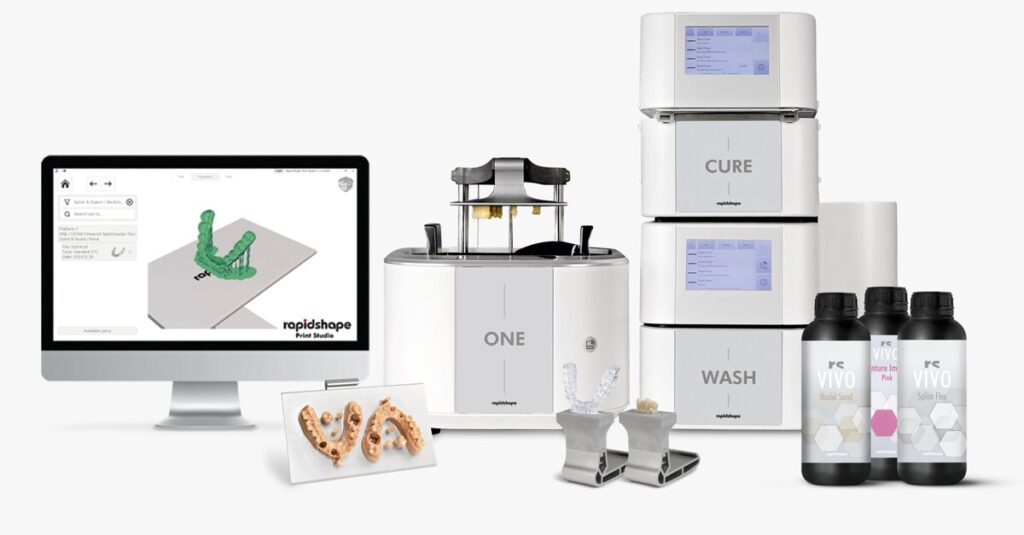
Synchronization of equipment, materials and software forms a digital ecosystem where each component affects the final clinical outcome — from scanning and CAD design to printing, cleaning, polymerization and finishing. Rapid Print Kit with compact resin containers reduces consumption and waste, ensures standardization of dosing and simplifies validation of each production cycle; this is important when implementing additive protocols in outpatient settings where resources and space are limited. Time savings — printing crowns or four-unit bridges in ~8 minutes, splints in ~60 minutes — represent a significant advantage for temporary or definitive prosthetic protocols, however clinicians need to control surface quality, degree of cure and the need for minimal polishing before try-in and cementation.
Integration: the printer and its decoding
The transition from separate devices to an integrated bundle is the key to reproducibility. Printer ONE achieves accuracy on the x–y axes of 34 micrometers, which clinically correlates with improved seating of restorations and a reduction in the amount of manual adjustment during try-in. The platform supports more than fifteen indications and validation of over fifty premium resins — this expands the applicability from single crowns to denture bases and surgical guides in the RS VIVO line. Material identification via radio-frequency tags increases workflow safety, minimizes the risk of loading incorrect resin and contributes to adherence to verification protocols.
Automation of post-processing and standardization
ONE integrates with WASH and CURE devices, implementing an automated cycle of cleaning, drying and 360-degree polymerization in a vacuum chamber; this reduces variability associated with manual post-processing and contributes to achieving repeatable mechanical properties and the degree of monomer conversion. Nevertheless clinicians and technicians should consider the impact of post-curing parameters on strength and biocompatibility — curing time and temperature, UV exposure intensity and vacuum treatment shape the final properties of the restoration, therefore it is recommended to follow manufacturer protocols and perform quality control on the first series of restorations.
Practical integration into the office
The system is designed for installation in a standard treatment room, integrating into the daily patient flow without the need for a separate laboratory or deep staff specialization. For successful implementation the following are necessary: team training, workspace planning, implementation of infection control protocols, validation of working parameters and documentation of clinical outcomes — all this ensures scalability from single urgent cases to complex digital protocols. In clinical practice it is advisable to start with low-risk indications — temporary crowns, guides, splints — and gradually expand the spectrum while conducting internal validation of fit, occlusal stability and long-term function.
Clinical limitations and expert remarks
Despite obvious advantages, the limitations of additive restorations should be considered: long-term durability under load, material behavior under fatigue loading in multi-unit bridges, the influence of thickness and anatomy on strength, as well as regulatory and laboratory control requirements depending on the jurisdiction. I recommend implementing quality control protocols — checking fit with decementation/test fixation, analysis of marginal adaptation under a microscope, measurement of edge thickness and documentation of clinical observations for further assessment of long-term outcome.
Conclusions and recommendations
The integrated ecosystem ONE and Rapid Print Kit represents a mature solution for in-office production of restorations in a single visit, combining high speed with material validation and automated post-processing. For safe and effective implementation I recommend: starting with a limited set of indications and materials, performing internal validation and recording clinical data, training staff and following post-processing and infection control protocols — this will ensure reproducibility of results, minimization of risks and improvement of patient treatment quality.
Modern dentistry is undergoing a large-scale transformation, accompanied by a shift of emphasis toward prevention, digital tools, and interdisciplinary cooperation
Modern dentistry is undergoing an intensive transformation, in which digital technologies, patients’ aesthetic expectations and interdisciplinary cooperation are shaping new
We use cookies to improve website performance, analyze traffic, and personalize content. You can accept all cookies or customize their use. Learn more in our Cookie Policy.
Functional
Always active
Technical storage or access is strictly necessary for the legitimate purpose of making possible the use of a particular service expressly requested by the subscriber or user, or solely for the purpose of carrying out the transmission of a message over an electronic communications network.
Preferences
The technical storage or access is necessary for the legitimate purpose of storing preferences that are not requested by the subscriber or user.
Statistics
Technical storage or access used solely for statistical purposes.The technical storage or access that is used exclusively for anonymous statistical purposes. Without a subpoena, voluntary compliance on the part of your Internet Service Provider, or additional records from a third party, information stored or retrieved for this purpose alone cannot usually be used to identify you.
Marketing
Technical storage or access is necessary to create user profiles for the purpose of sending advertising or to track a user across a website or multiple websites for similar marketing purposes.