
Diagnostic AI in Dentistry: Calibrated Uncertainty and Transformation of Clinical Interpretation

Variability in the interpretation of dental radiographs between clinicians remains a significant problem, and research documents low detection rates for some subtle findings, particularly proximal caries at the enamel level. BeCertain — a spin-off from King’s College London and University of Surrey — offers a solution through the use of artificial intelligence to improve consistency in the interpretation of dental radiographs. The company has raised £1.7 million (€2.0 million) in an early-stage funding round to develop the technology and expand commercial operations.

Technology oriented toward clinician trust

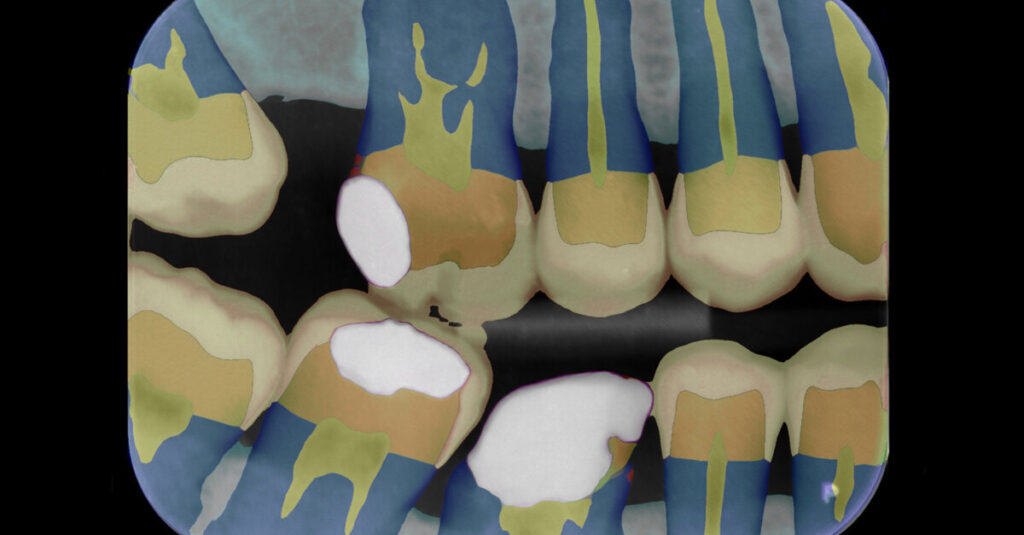
BeCertain’s software uses a proprietary uncertainty-aware algorithm to detect caries, bone resorption, infectious processes, and defects in existing restorations on two-dimensional intraoral radiographs. The key feature is that the system not only identifies suspicious findings but also indicates how reliable each result is.

The system provides calibrated confidence scores, allowing dentists to assess the credibility of each conclusion. Patient data protection is built into the system architecture. The technology integrates with existing dental imaging systems and is designed to support clinical protocols, enhancing diagnostic reliability and practice efficiency.

Key distinction: calibrated uncertainty

While existing AI systems already detect many similar findings and some display confidence values, BeCertain makes calibrated uncertainty a central element of its clinical output. As noted by Dr. Yunpeng Li, chief executive officer and co-founder of BeCertain, “the hard part in clinical AI is not detection; it is trust. That is what we have built: a system that tells clinicians how confident it is in the result, rather than issuing an unclear verdict.”

The technology was developed based on research led by Dr. Li and Prof. Owen Addison (head of the Centre for Oral, Clinical and Translational Sciences) from King’s College London. Prof. Addison, co-founder of BeCertain and chief medical advisor, emphasized: “BeCertain is aimed at making dentistry more efficient for clinicians and patients by applying regulated, reliable AI that gives clinicians confidence, consistency, and more time to work with patients.”

Support across the development trajectory

The project previously received £1.75 million for product development from the National Institute for Health and Care Research. The new funding round was led by Sure Valley Ventures with support from Innovate UK’s Growth Catalyst program under the Investor Partnerships model.

Prof. Lisa Collins, pro-vice-chancellor for research and innovation at University of Surrey, noted that BeCertain’s path “from research at University of Surrey to commercial development at King’s College London demonstrates the value of collaboration between institutions.”

Source

Original publication

Leave a Reply

Your email address will not be published. Required fields are marked *

Other news

Subscription to thousands of useful articles, 600 lessons, reviews & ratings

Subscribe to the newsletter

More news in our Telegram!

Congratulations!
You have successfully registered