Main » Uncategorized » Ivoclar Ivotion Dent Multi Palette: 14 shades and transformation of digital prosthetics
Ivoclar Ivotion Dent Multi Palette: 14 shades and transformation of digital prosthetics
Modern dentistry is undergoing an intensive transformation, in which digital technologies, patients’ aesthetic expectations and interdisciplinary cooperation are shaping new standards of care. The key challenge — is to bring materials and technological protocols into a unified system of reproducible color rendition and morphology that takes into account age-related, ethnic and individual characteristics of gingival tissues, as well as compatibility with digital CAD/CAM processes and laboratory protocols.
Gingiva as a key factor
Precision reproduction of gingival tissues becomes a clinically significant parameter not only for aesthetics but also for the predictability of prosthetic outcomes — especially in cases of combined implant-supported restorations, conditionally removable prostheses and in anterior restorations with a visible gingival zone. The introduction of the new gingival shade Shade D allows more accurate reproduction of color variations, gradients and age-related changes of the peripheral gingiva, which reduces the risk of metamerism with differences in lightness between the clinic and the laboratory; this requires clinicians and technicians to apply coordinated shade selection methods — visual using shade guides, spectrophotometry, digital photographic documentation and standardized lighting conditions — as well as validation of working protocols to ensure reproducibility between digital files and milled/post-processed components.
Ivotion Dent Multi: term and its decoding
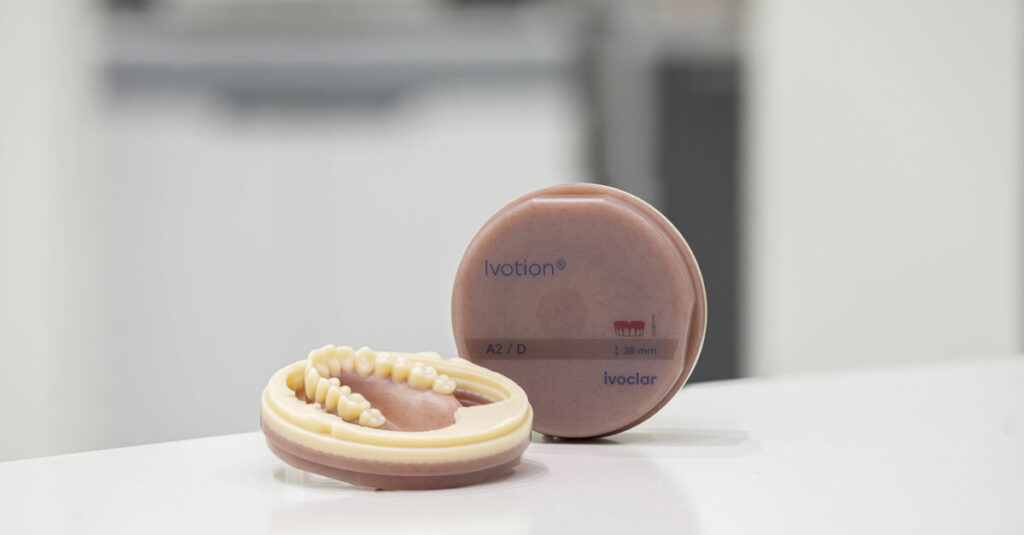
Expanding the range of the multichromatic disc Ivotion Dent Multi by five tooth shades A4, B2, C3, C4 and D3 increases the palette capacity to 14 shades, which facilitates the selection of transitional gradients without additional manual characterization and reduces operative time expenditures for laboratory processing. The 20 mm thick disc is designed for reliable milling in CAD/CAM workflows and is optimized in physical parameters for integration into digital work processes, while the manufacturer emphasizes a harmonious gradient of double cross-linked material providing the required degree of opalescence and translucency. For practicing clinicians and dental technicians this means the need to verify adhesive protocols, control interphase adaptation, assess the optical properties of finished restorations under standard lighting conditions and document clinical outcomes for subsequent evaluation of long-term aesthetic indicators.
Schaan as a strategic platform
Ivoclar’s headquarters in Schaan (Liechtenstein) functions as a center for development and validation of innovations, where laboratory and clinical partnerships support the standardization of protocols and training; the presence of educational initiatives, clinical trainings and knowledge dissemination networks contributes to the accelerated diffusion of new materials and the reduction of barriers to implementation in clinical practice. Such a corporate environment stimulates the synchronization of clinical trial data, laboratory checks and manufacturing standards, which is important for forming sustainable recommendations for the use of new shades in real-world practice.
Clinical significance and recommendations
Practical implementation of new shades requires a systemic approach: when planning aesthetic restorations it is necessary to take into account the baseline gingival pigmentation, the degree of marginal recession expression and the thickness of the soft tissues, to combine visual shade selection methods with digital systems and to ensure exchange of DICOM/3D STL and color information between the clinic and the laboratory; laboratories must calibrate milling equipment for a 20 mm thickness, verify finishing parameters and polishing protocols, and clinicians — document results under standardized lighting and, if necessary, use try-ins and corrective stainings prior to final cementation. Systematic collection of clinical data and feedback between practice and manufacturer will contribute to optimization of shade selection algorithms and reduction of result variability.
Conclusion
The introduction of the gingival shade Shade D and the expansion of the Ivotion Dent Multi palette reflect the trend toward personalization and digitalization of prosthetics — the integration of extended color solutions into CAD/CAM processes increases the predictability of aesthetic outcomes and accelerates laboratory-clinical work cycles, while successful implementation requires standardization of shade selection protocols, validation of adhesive and milling parameters and active exchange of clinical information between the clinician and the dental technician.
Modern dentistry is undergoing a large-scale transformation, accompanied by a shift of emphasis toward prevention, digital tools, and interdisciplinary cooperation
We use cookies to improve website performance, analyze traffic, and personalize content. You can accept all cookies or customize their use. Learn more in our Cookie Policy.
Functional
Always active
Technical storage or access is strictly necessary for the legitimate purpose of making possible the use of a particular service expressly requested by the subscriber or user, or solely for the purpose of carrying out the transmission of a message over an electronic communications network.
Preferences
The technical storage or access is necessary for the legitimate purpose of storing preferences that are not requested by the subscriber or user.
Statistics
Technical storage or access used solely for statistical purposes.The technical storage or access that is used exclusively for anonymous statistical purposes. Without a subpoena, voluntary compliance on the part of your Internet Service Provider, or additional records from a third party, information stored or retrieved for this purpose alone cannot usually be used to identify you.
Marketing
Technical storage or access is necessary to create user profiles for the purpose of sending advertising or to track a user across a website or multiple websites for similar marketing purposes.