Main » Uncategorized » Rural Integrated Model in Wisconsin: Developing Accessible Dentistry Through Partnership and Technology Integration
Rural Integrated Model in Wisconsin: Developing Accessible Dentistry Through Partnership and Technology Integration
Dr. Matt Andrews created an innovative model of dental care delivery in rural Wisconsin by integrating dental practices into the structure of regional medical centers. Growing up in Cuba City, Wisconsin, in a family of healthcare workers, Andrews initially planned to attend medical school, however a conversation with a dentist during a routine appointment in his third year of college reoriented his professional ambitions and opened the possibility of returning to his hometown to serve the local community.
History of practice development
After graduating from Marquette University School of Dentistry in 2008, Andrews immediately put this idea into practice. Literally days after receiving his diploma and the birth of his first child, he began working in a dental office in his hometown. By 2010, he had acquired this practice, and within a few years, the growing number of patients required building a new complex from scratch. The development of the practice was driven not only by growing demand, but also by a deeper goal — to expand access to quality dental care in rural areas. The success and reputation attracted young colleagues eager to join the team after completing their training, which became the impetus for opening several branch offices.
Model of integrated care: concept and implementation
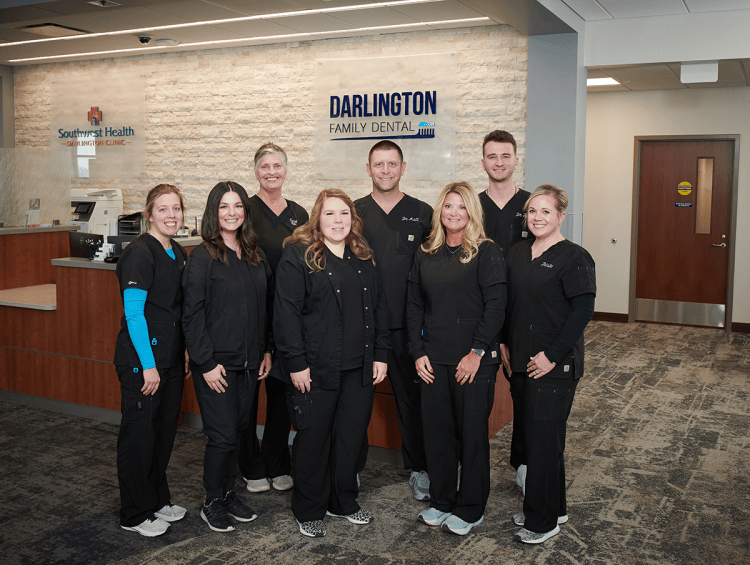
A turning point in the development of Andrews’ practice was the opening of two additional locations in Kieler and Darlington, located on the territory of regional medical centers. The key innovation was the co-location of dental, medical, and specialist offices under one roof, allowing patients to receive comprehensive care in a single location.
The idea developed from practical interaction: when Andrews learned of plans to build a medical center in Kieler, he proposed collaboration and joint design. Partnership with Patterson Dental provided professional architectural and engineering solutions — including CAD modeling of office layouts, alignment of clinical requirements with center architecture, equipment selection, integration of digital technologies, and ongoing maintenance of systems.
The result of this integration proved to be clinically and organizationally significant. Patients gain access to dental care near emergency services, physical therapy, and primary care offices in one place, which optimizes referral pathways and reduces the number of visits. An increased patient flow supports the economic viability of both practices, while shared reception areas create organizational efficiencies without compromising their operational independence.
Operational infrastructure and technical support
Behind the visible success lies a reliable operational foundation. Patterson Dental ensures the continuous operation of all three of Andrews’ locations through cloud-based practice management systems that connect the offices into a single information network and simplify communication across a growing team of doctors and staff. Specialized technical support — remote troubleshooting of equipment, consultation during construction and equipping of new offices — ensures the absence of critical failures in operation and maintains a high level of readiness of clinical facilities.
Vision and principles of rural dentistry development
Andrews’ mission has remained unchanged throughout his career: to provide high-quality dental care in comfortable conditions, minimizing the number of visits while simultaneously strengthening the health and well-being of the community. By combining innovative technologies, effective collaboration between specialists of different profiles, and reliable business partnerships, he has created a model that demonstrates practical viability in a rural context and points to the future of an integrated healthcare system.
According to Andrews himself, the essence of his approach lies in continuous process improvement: “What captivates me about dentistry is not repeating the same thing in the same way, but finding better ways to do it faster and more efficiently to serve the community. This has always been our principle.” This principle reflects a deep understanding that practice development is not only an expansion of volume, but a continuous optimization of the quality and accessibility of care for patients in regions with limited resources.
Modern dentistry is developing as one of the most dynamic areas of medicine, intensively implementing digital and organizational innovations. Emotional
We use cookies to improve website performance, analyze traffic, and personalize content. You can accept all cookies or customize their use. Learn more in our Cookie Policy.
Functional
Always active
Technical storage or access is strictly necessary for the legitimate purpose of making possible the use of a particular service expressly requested by the subscriber or user, or solely for the purpose of carrying out the transmission of a message over an electronic communications network.
Preferences
The technical storage or access is necessary for the legitimate purpose of storing preferences that are not requested by the subscriber or user.
Statistics
Technical storage or access used solely for statistical purposes.The technical storage or access that is used exclusively for anonymous statistical purposes. Without a subpoena, voluntary compliance on the part of your Internet Service Provider, or additional records from a third party, information stored or retrieved for this purpose alone cannot usually be used to identify you.
Marketing
Technical storage or access is necessary to create user profiles for the purpose of sending advertising or to track a user across a website or multiple websites for similar marketing purposes.