Main » Reviews and ratings » Reliability and durability of dental handpieces: clinical experience and technological priorities of modern practice
Reliability and durability of dental handpieces: clinical experience and technological priorities of modern practice
Modern dentistry is unimaginable without high-precision rotary instruments, among which straight and contra-angle handpieces hold a special place. These devices are not just auxiliary equipment but a fundamental element of clinical activity, on which the quality of treatment, the comfort of the doctor, and the safety of the patient directly depend. In the context of increasing workloads on dental institutions, as well as the increasing complexity of clinical tasks, issues of reliability, durability, and robustness of equipment acquire particular significance.
The publication under consideration focuses on the practical experience of using handpieces in a university clinic setting, which allows assessing their effectiveness not in laboratory conditions but in real clinical settings. This approach is particularly important because it is long-term operation in an intensive mode that reveals the true characteristics of medical equipment.
Clinical experience of use: the reliability factor
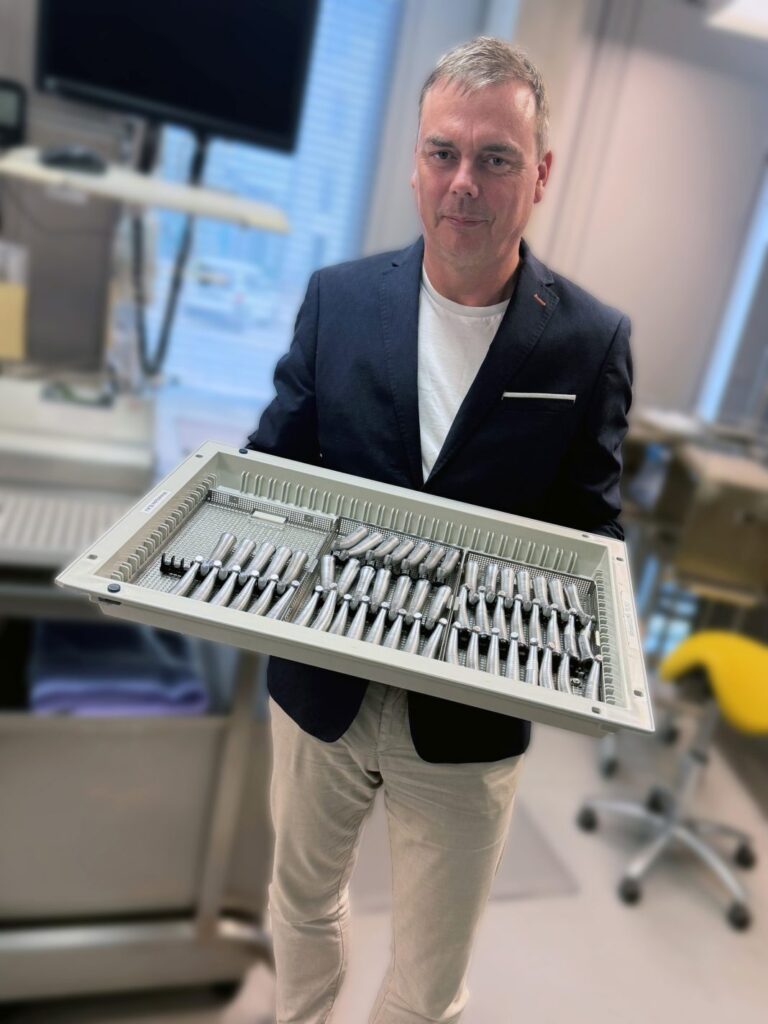
The material is based on the experience of the dental clinic at the University of Witten/Herdecke, where straight and contra-angle handpieces from one of the leading manufacturers have been used for a long time. It is noted that when working with a large number of instruments, the key selection criteria are not only technical characteristics but also wear resistance and a long service life .
It is emphasized that under conditions of high clinical load, equipment must demonstrate stable operation without frequent breakdowns or the need for replacement. Practical experience shows that it is durability that becomes a determining factor in economic efficiency, as it reduces maintenance costs and downtime.
Technological characteristics and functional significance
Modern contra-angle handpieces are complex mechanical systems that transmit rotational motion from the micromotor to the working instrument. Their design makes it possible to achieve high precision in tissue processing, as well as to provide access to hard-to-reach areas of the oral cavity due to their characteristic angular geometry.
The functional capabilities of such instruments cover a wide range of clinical tasks, including therapeutic treatment, endodontics, implantology, and preventive procedures. Their versatility makes handpieces indispensable in daily practice, and the demands on their reliability are especially high.
Durability as an economic and clinical factor
Special attention in the publication is paid to the relationship between the service life of equipment and the efficiency of the clinic. It is noted that handpieces that demonstrate stable operation over many years can significantly reduce operating costs. In some cases, individual instruments remain functional for more than a decade, which indicates a high level of engineering sophistication and the quality of the materials used. At the same time, durability is considered not only as an economic indicator but also as a factor in clinical reliability. Stable operation of the instrument reduces the risk of complications, increases the precision of manipulations, and ensures the predictability of treatment results.
The role of ergonomics and comfort in clinical practice
In addition to technical reliability, significant attention is paid to the ergonomic characteristics of handpieces. Modern models are developed with the need to reduce doctor fatigue in mind, which is especially important during long procedures. Lightweight construction, optimal balance, and reduced noise levels contribute to improving the quality of work and comfort for both the specialist and the patient. Furthermore, modern handpieces are equipped with cooling systems and built-in illumination, which improves visualization of the operative field and prevents tissue overheating. These elements are becoming standard for equipment aimed at high clinical results.
Innovations and technology development
Developments in dental handpiece technology are aimed at increasing their performance, reliability, and ease of use. Manufacturers are introducing new materials, including high-strength alloys and ceramic bearings, as well as improving internal motion transmission mechanisms. Modern solutions make it possible to combine high rotational speeds with sufficient torque, ensuring both efficient hard tissue processing and precision when performing delicate procedures. As a result, a new generation of instruments is being formed, capable of meeting the demands of the most complex clinical tasks.
Significance for modern dentistry
Analysis of the presented material allows us to conclude that the reliability of dental handpieces is a key factor in the sustainability of clinical practice. In conditions of high competition and growing demands for quality of treatment, the choice of equipment becomes a strategic decision affecting the efficiency of the entire medical organization.
The use of durable and technologically advanced instruments contributes to improving the quality of care provided, reducing operational costs, and enhancing the overall level of service. This is especially important in large clinics and educational institutions, where equipment is subjected to intensive use.
Conclusion
Thus, the publication emphasizes the importance of the reliability and durability of straight and contra-angle handpieces as one of the key elements of modern dental practice. The presented clinical experience demonstrates that investments in high-quality equipment pay off not only from an economic point of view but also in the context of increasing treatment efficiency.
The relevance of this topic is driven by the need to ensure stable and safe operation of dental institutions in the face of constantly growing demands for the quality of medical care. In the future, further technological development will be aimed at creating even more reliable, ergonomic, and intelligent instruments capable of integrating into the digital ecosystem of modern dentistry.
We use cookies to improve website performance, analyze traffic, and personalize content. You can accept all cookies or customize their use. Learn more in our Cookie Policy.
Functional
Always active
Technical storage or access is strictly necessary for the legitimate purpose of making possible the use of a particular service expressly requested by the subscriber or user, or solely for the purpose of carrying out the transmission of a message over an electronic communications network.
Preferences
The technical storage or access is necessary for the legitimate purpose of storing preferences that are not requested by the subscriber or user.
Statistics
Technical storage or access used solely for statistical purposes.The technical storage or access that is used exclusively for anonymous statistical purposes. Without a subpoena, voluntary compliance on the part of your Internet Service Provider, or additional records from a third party, information stored or retrieved for this purpose alone cannot usually be used to identify you.
Marketing
Technical storage or access is necessary to create user profiles for the purpose of sending advertising or to track a user across a website or multiple websites for similar marketing purposes.