Main » Uncategorized » Planmeca Pro40 and Pro50 S: two units and the formation of a predictable digital clinical environment
Planmeca Pro40 and Pro50 S: two units and the formation of a predictable digital clinical environment
Modern dental practice is rapidly integrating digital solutions and ergonomic concepts, forming a new professional paradigm of patient care.
In conditions where the priorities remain treatment predictability and standardization of infection control, the introduction of new units must be considered through the prism of clinical reproducibility, ergonomics and IT compatibility. This analysis examines the functionality and clinical significance of the presented Planmeca units Pro40 and Pro50 S, relying on the manufacturer’s description and practical considerations for general dental practitioners and specialized clinics.
Ergonomics and clinical reproducibility
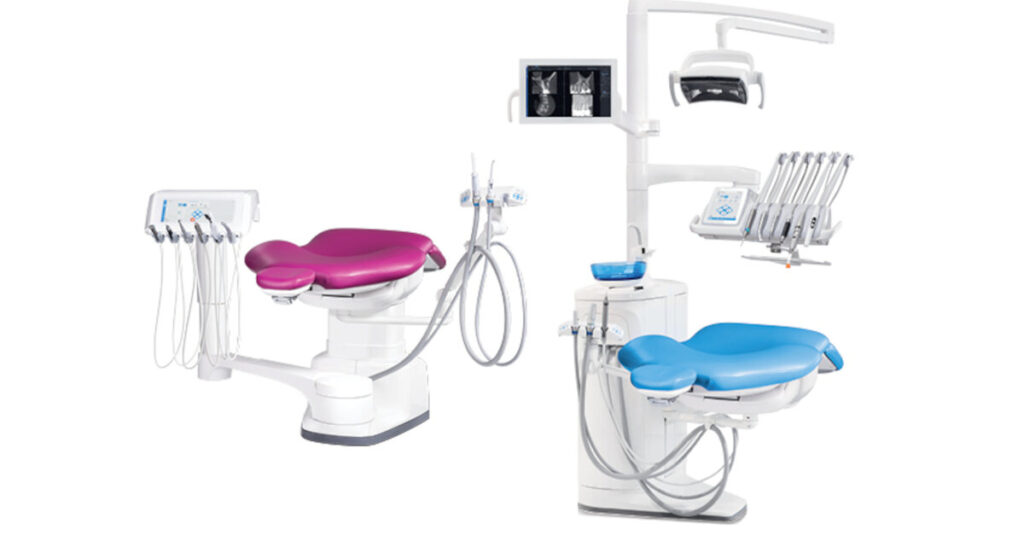
Pro40 has retained a lateral lift design, providing a wide range of chair movement and optimal access for the dentist and assistant — this is critical for maintaining work balance in complex restorations and surgical procedures where synchronization of manipulations and instrumental assistance is required. The viscoelastic upholstery Ultra Relax with a memory effect increases the stability of patient positioning, which reduces the need for frequent repositioning during lengthy procedures and increases the predictability of obtaining orthopantomograms and intraoral visualization.
Support for six instruments and a permissible patient mass of 200 kg allow procedures to be performed on a wide range of patients without compromise to safety and accessibility of manipulations, which is important when working with comorbid patients and when additional devices such as surgical handpieces, endomotors and polishing systems are required. From an ergonomic perspective for staff, this reduces the frequency of instrument changes and the load on the operative position, which impacts the reduction of occupational musculoskeletal disorders in dentists and assistants.
Digital integration and workflows
The informational component becomes key for optimizing clinical protocols and quality management — here interface, centralized data validation and usage analytics are important.
Interface and data management
Pro40 is equipped with a 7‑inch user interface with intelligent software and support for user profiles via PlanID, which contributes to the personalization of settings, speeds entry into the work session and reduces the risk of errors related to incorrect instrument parameters. For clinics this means the ability for centralized management of protocols, version control of settings and subsequent analysis of usage — elements important for internal validation of the quality of care provided.
Pro50 S: screen and integration with Romexis
Pro50 S offers a large 12,3‑inch screen and direct connection to the Romexis platform, which simplifies synchronization with digital images, three‑dimensional visualization and navigation systems. The presence of network analytics allows not only to collect statistics but also to use them to optimize work protocols, monitor compliance with infection control standards and assess clinical outcomes at the level of the operatory and the clinic network.
Logistics, materials and compatibility
The announcement in Helsinki emphasizes the brand’s international strategy and focus on export logistics, while the design solutions are oriented toward rationalizing supply chains and environmental requirements — the compact modular design of Pro50 S is made using recyclable aluminum and optimized to reduce transport volume and component disposal.
Compatibility of Pro40 with existing units Compact i5 and Compact I Classic facilitates phased modernization of clinics, reduces capital expenditures when upgrading the equipment fleet and minimizes downtime; upon implementation this allows preserving standardized service protocols and simplifying staff training.
Clinical conclusions and practical recommendations
For practicing dentists when evaluating innovations the following should be considered: the impact of ergonomics on procedure duration and the frequency of operative postures; the impact of upholstery materials and panel construction on disinfection efficiency and compliance with infection control standards; integration capabilities with existing DICOM/EMR‑systems and digital imaging protocols; the possibilities of collecting and analyzing data for internal validation of clinical results and quality management. I recommend conducting pilot testing in real work scenarios with documentation of metrics — procedure time, number of patient repositionings, convenience of assistant access, adherence to sterility protocols and integration of data into Romexis or local EMR — for a substantiated conclusion about the cost‑effectiveness and clinical efficiency of implementation.
In addition, it is critically important to consider cybersecurity and confidentiality issues when transmitting clinical data through network platforms, ensure regular software updates and staff training on working with digital systems and backup protocols to preserve the integrity of medical information.
Advancement of materials for dental 3D printing significantly expands the possibilities for manufacturing personalized temporary restorations and prosthodontic constructions directly
We use cookies to improve website performance, analyze traffic, and personalize content. You can accept all cookies or customize their use. Learn more in our Cookie Policy.
Functional
Always active
Technical storage or access is strictly necessary for the legitimate purpose of making possible the use of a particular service expressly requested by the subscriber or user, or solely for the purpose of carrying out the transmission of a message over an electronic communications network.
Preferences
The technical storage or access is necessary for the legitimate purpose of storing preferences that are not requested by the subscriber or user.
Statistics
Technical storage or access used solely for statistical purposes.The technical storage or access that is used exclusively for anonymous statistical purposes. Without a subpoena, voluntary compliance on the part of your Internet Service Provider, or additional records from a third party, information stored or retrieved for this purpose alone cannot usually be used to identify you.
Marketing
Technical storage or access is necessary to create user profiles for the purpose of sending advertising or to track a user across a website or multiple websites for similar marketing purposes.