Main » Uncategorized » Partnership between VOCO and Formlabs: standardization of working protocols and clinical predictability
Partnership between VOCO and Formlabs: standardization of working protocols and clinical predictability
The field of digital dentistry is in a phase of active transformation, based on the integration of additive technologies and new materials, shaping the workflows of laboratories and clinics.
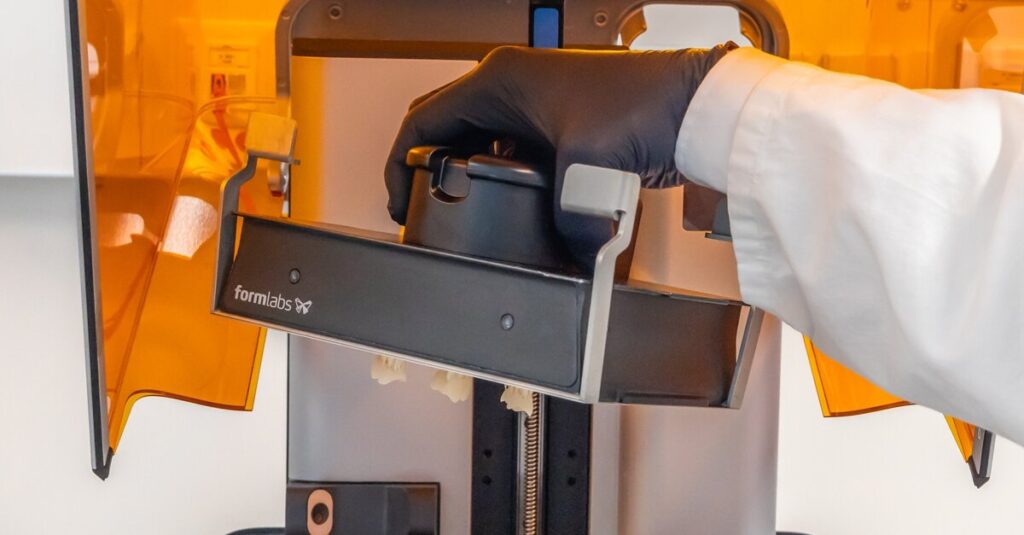
Key challenge consists in ensuring reproducibility and predictability of results while simultaneously expanding the range of compatible materials and lowering adoption barriers for practitioners — the partnership of VOCO and Formlabs is presented as a practical platform allowing the use of V‑Print photopolymer materials on the Form 4B printer, which translates technological capabilities into clinical practice and requires systematic validation of work protocols and quality control.
Materials as a key factor
V‑Print c&b temp and V‑Print dentbase demonstrate a combination of clinically significant properties and technological convenience — high esthetics due to natural fluorescence and resistance to staining, a flexural strength value of 132 MPa and a wear level of approximately 119 μm confirm suitability for extended temporary restorations and removable denture bases. For the clinician and technician, parameters such as the degree of polymerization, surface after post-polymerization, the possibility of mechanical processing and polishing, biocompatibility and compliance with regulations are important — verification of these characteristics at the implementation stage minimizes the number of reworks and repeat patient visits.
Clinical indications and limitations
The materials are indicated for temporary crowns and bridges, removable denture bases and template-type elements — while it is necessary to take into account limits of mechanical load, occlusal relationships and duration of use; it is recommended to perform testing on typical blocks and assessment of esthetic characteristics in clinic and laboratory conditions before serial application.
Open Material Mode: compatibility and settings
Compatibility of V‑Print resins with the Form 4B is provided via Open Material Mode, which opens the possibility of integrating third-party materials into protected digital ecosystems of printing and post-processing — this approach requires synchronization of standards, documented validation and transparent post-polymerization protocols. The availability of recommended parameters for Form Cure V2 and detailed printing parameters accelerates implementation; however, a clinically responsible approach implies verification of each parameter: layer thickness, exposure density, time and mode of post-polymerization, temperature control and possible additional thermal treatment.
The role of software modes and verification
Software modes move from being options to becoming tools of standardization — for laboratories this means the necessity to create quality control protocols, including regular calibration of the printer, test printing of reference samples, documentation of settings and comparative assessment of the mechanical and esthetic characteristics of the material.
Cuxhaven as a strategic site
The origin of the materials in Cuxhaven emphasizes the transnational nature of cooperation between manufacturers and contributes to the transformation of traditional clinic-laboratory models toward greater automation; the absence of shrinkage in additive manufacturing of denture bases improves fit accuracy and reduces the risk of pressure sores and irritations in patients. Packs of 500 g for V‑Print c&b temp are aimed at operative production (about 500 crowns as stated by the manufacturer), and the 1 000 g bottle for V‑Print dentbase is intended for serial production in laboratories, which affects procurement planning and process economics. The absence of a need for an inert atmosphere during post-polymerization reduces processing time and operational costs, however clinics must consider equipment and protocol requirements for a stable result.
Impact on clinical and laboratory workflows
The VOCO and Formlabs partnership illustrates the development of dentistry as an integrated ecosystem, where digital technologies, joint validation of materials and standardization of protocols increase the predictability and quality of treatment — this affects the chain: from CAD/CAM planning and printing parameters to post-processing, try-in and final fixation. For practice this means the necessity to implement systems for tracking versions of materials and firmware, regulated control procedures and continuous staff training.
Practical recommendations and key control points
Recommendations for implementation — verify print and post-polymerization parameters on test samples; document the batch of material, serial number and firmware version of the printer; monitor mechanical indicators (flexural strength, wear), esthetics (color, fluorescence) and adaptation of bases; perform scheduled maintenance of equipment and staff training; integrate quality control protocols into the electronic documentation of the laboratory and clinic.
Conclusion: collaboration between manufacturers and open material integration modes create prerequisites for more predictable, economical and reproducible digital production of temporary restorations and denture bases, but a sustained clinical effect requires systematic validation, documented protocols and continuous professional education.
We use cookies to improve website performance, analyze traffic, and personalize content. You can accept all cookies or customize their use. Learn more in our Cookie Policy.
Functional
Always active
Technical storage or access is strictly necessary for the legitimate purpose of making possible the use of a particular service expressly requested by the subscriber or user, or solely for the purpose of carrying out the transmission of a message over an electronic communications network.
Preferences
The technical storage or access is necessary for the legitimate purpose of storing preferences that are not requested by the subscriber or user.
Statistics
Technical storage or access used solely for statistical purposes.The technical storage or access that is used exclusively for anonymous statistical purposes. Without a subpoena, voluntary compliance on the part of your Internet Service Provider, or additional records from a third party, information stored or retrieved for this purpose alone cannot usually be used to identify you.
Marketing
Technical storage or access is necessary to create user profiles for the purpose of sending advertising or to track a user across a website or multiple websites for similar marketing purposes.