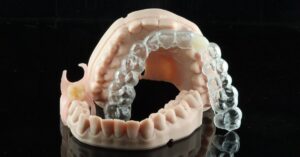
Main » Uncategorized » Orthodontic aligners: production strategy and clinical control in digital practice
Orthodontic aligners: production strategy and clinical control in digital practice
An orthodontic practice offering treatment with removable transparent aligners inevitably faces a strategic question: entrust production to external partners or establish it directly in the clinic. The choice of model affects clinical control, manufacturing timelines, costs, and diagnostic quality.
Commercial providers: standardization and scale
Working with large aligner manufacturers involves relying on mass production, brand recognition, and developed marketing infrastructure. This approach provides direct promotion of treatment to consumers, increasing its recognition; planning based on standardized digital processes; access to proven digital platforms, although the closed architecture of systems may limit flexibility; stable manufacturing quality due to well-established production processes; loyalty programs that, however, are not always optimal for each patient.
This model is convenient for practices without their own equipment and personnel, but reduces flexibility in adapting costs and processes to specific clinical situations.
Local laboratories: flexibility and collaboration
Working with local laboratories involves a more personalized approach: direct communication with technicians and the possibility of consultations; adaptation of the treatment plan to specific patient data; flexible pricing and potentially reduced manufacturing timelines; involvement of experienced specialists in developing solutions for complex cases.
The disadvantage is that part of the work remains outside the clinic’s control, and quality may vary depending on the laboratory personnel’s qualifications.
In-house production: control and independence
In-clinic aligner production allows the practice to maintain full control over diagnostics, planning, and technical processes. Advantages include reduced time from diagnosis to production through digital tools integration; direct clinician participation in the treatment plan with artificial intelligence support; readiness for operative correction during therapy; independence in the choice of materials and production procedures; ability to manufacture replacement of lost or damaged aligners without contacting external suppliers; branded treatment delivery.
However, this approach requires appropriate equipment, trained personnel, and quality control systems, which entails significant capital and operational costs.
Digital workflow for in-clinic production
Diagnostic modeling (DDP AI)
The program processes intraoral or extraoral scans and prepares a three-dimensional model for subsequent analysis and treatment planning.
Treatment planning (DDP-Ortho)
Includes diagnostic analysis based on scans and images, cephalometry (assessment of skull dimensions and proportions), virtual tooth positioning, and visualization of the prognosis for achieving the target occlusal relationship.
Technical manufacturing (DTS Aligner Planner)
Prepares three-dimensional models for 3D printer output, plans the sequence of tooth movements at each treatment stage, and calculates the need for interproximal reduction (reduction of contact points between teeth to facilitate movement).
The clinician remains responsible for diagnostics, planning, and treatment monitoring, regardless of whether the technical stages are performed within the clinic or delegated to a specialist.
Hybrid approach
Many practices combine production models: a number of standard cases are performed in-clinic, reducing processing time; complex clinical situations or those requiring special equipment are referred to certified laboratories. This approach optimizes the balance between quality control and cost-effectiveness.
Model selection and clinical philosophy
The choice between outsourcing and in-house production reflects not only technical capabilities but also the philosophy of clinical work: the desire for maximum control over all treatment stages, including its technical aspects, or a preference for partnership with external specialists, allowing the clinician to focus on direct patient interaction and monitoring of orthodontic results.
Advancement of materials for dental 3D printing significantly expands the possibilities for manufacturing personalized temporary restorations and prosthodontic constructions directly
We use cookies to improve website performance, analyze traffic, and personalize content. You can accept all cookies or customize their use. Learn more in our Cookie Policy.
Functional
Always active
Technical storage or access is strictly necessary for the legitimate purpose of making possible the use of a particular service expressly requested by the subscriber or user, or solely for the purpose of carrying out the transmission of a message over an electronic communications network.
Preferences
The technical storage or access is necessary for the legitimate purpose of storing preferences that are not requested by the subscriber or user.
Statistics
Technical storage or access used solely for statistical purposes.The technical storage or access that is used exclusively for anonymous statistical purposes. Without a subpoena, voluntary compliance on the part of your Internet Service Provider, or additional records from a third party, information stored or retrieved for this purpose alone cannot usually be used to identify you.
Marketing
Technical storage or access is necessary to create user profiles for the purpose of sending advertising or to track a user across a website or multiple websites for similar marketing purposes.