Main » New in Dentistry » Longevity of veneers in complex esthetic cases: six‑year follow‑up as evidence of the effectiveness of minimally invasive approaches
Longevity of veneers in complex esthetic cases: six‑year follow‑up as evidence of the effectiveness of minimally invasive approaches
Esthetic dentistry in recent years has shown a steady shift toward minimally invasive treatment methods aimed at preserving natural tooth tissue while achieving high visual results. Veneers, as one of the key tools in esthetic rehabilitation, occupy a central place in this paradigm. However, the question of their longevity, especially in complex clinical situations, continues to be a subject of scientific interest and professional debate.
The publication under review, titled “Minimally invasive placement of lithium disilicate veneers in the esthetic zone using digital smile design: a case report with 6‑year follow‑up,” was published online on February 17, 2026, in the journal Frontiers in Dental Medicine and focuses on a clinical case with a six‑year follow‑up evaluating the effectiveness of veneers placed under conditions of complex esthetic and functional pathology. The material is of particular value because it not only demonstrates a successful treatment outcome but also confirms its stability over time, which is a key quality criterion in modern dentistry.
Clinical context and complexity of the initial situation
In the presented clinical case, the patient had a number of anatomical and functional features complicating esthetic restoration. These included altered passive eruption, a mild Class II Division 2 malocclusion, and palatal inclination of the upper incisors. In standard clinical practice, such conditions often require comprehensive orthodontic treatment aimed at correcting tooth position and restoring functional balance.
However, the patient refused orthodontic intervention, which necessitated the search for an alternative, less invasive solution. As a result, a strategy based on digital smile design and the use of lithium disilicate ceramic veneers combined with surgical gum correction was chosen.
Digital planning as the foundation of a predictable outcome
One of the key aspects of the treatment was the use of digital technologies to model the future outcome. The use of Digital Smile Design made it possible not only to visualize the anticipated treatment result but also to ensure a high degree of accuracy during its execution. This approach plays an important role in modern clinical protocols, as it allows for the consideration of biomechanical features, facial anatomy, and the patient’s individual esthetic parameters. In complex clinical cases, this becomes a critically important factor determining treatment success.
Minimally invasive strategy and material selection
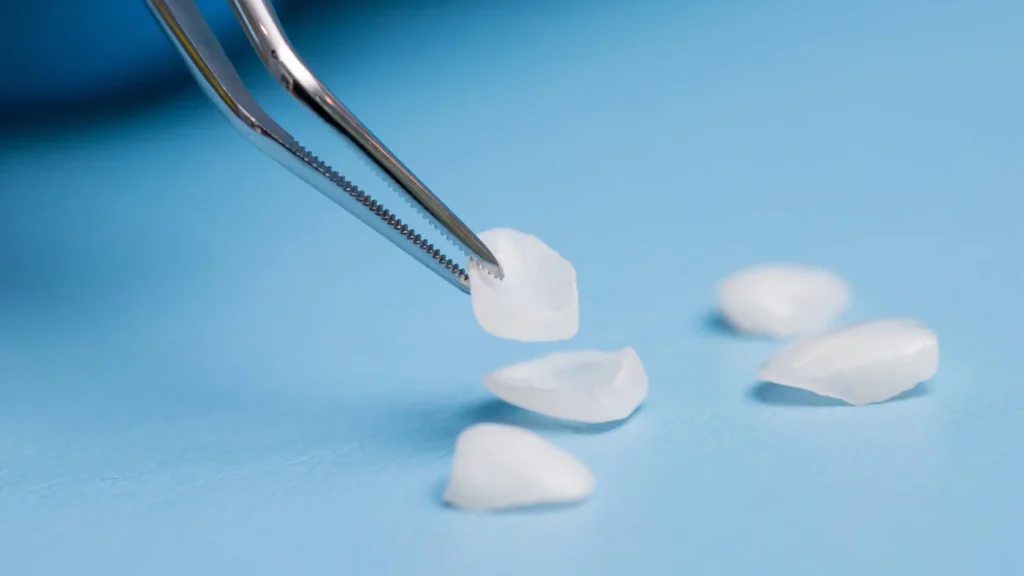
Thin laminated lithium disilicate veneers, characterized by high strength and esthetic properties, were used as the main restorative solution. Their application allowed for minimal tooth preparation, preserving a significant portion of natural tissue. In this case, the minimally invasive approach not only reduced the biological load on the teeth but also provided favorable conditions for the long‑term stability of the restorations. Such a strategy aligns with the current principles of dentistry aimed at tissue preservation and the prevention of excessive intervention.
Results of the six‑year follow‑up
A key element of the publication is the analysis of the clinical condition of the restorations six years after their placement. The obtained data indicate high stability of both the functional and esthetic characteristics of the veneers. During the entire follow‑up period, no serious complications such as chipping, debonding, or pronounced discoloration of the restorations were recorded. Additionally, the health of the surrounding soft tissues was maintained, indicating the biocompatibility of the materials used and the correctness of the chosen clinical approach. The patient also continued to express satisfaction with the treatment outcomes, which is an important indicator of successful esthetic rehabilitation.
Interpretation of the results and their significance for practice
Although the presented material is based on a single clinical case, its significance extends beyond an individual observation. It demonstrates that even under constraints related to a patient’s refusal of orthodontic treatment, a stable and long‑lasting result can be achieved provided there is proper planning and technique selection. Particular attention in the publication is given not so much to the novelty of the technologies used but to their comprehensive and well‑justified combination. It is precisely the integration of digital planning, minimally invasive preparation, and modern materials that enabled the achievement of excellent results in a complex clinical situation.
Significance for modern esthetic dentistry
The obtained data confirm the growing role of conservative treatment methods in esthetic dentistry. Veneers, when properly planned and executed, can provide long‑term functional and esthetic stability, making them an important tool in the clinician’s arsenal. In a broader context, this clinical case reflects the trend toward individualized treatment and the shift from standard protocols to personalized solutions that take into account both medical factors and patient preferences. This aligns with the modern requirements of patient‑centered medicine.
Conclusion
Thus, the six‑year clinical follow‑up confirms the high effectiveness and longevity of veneers even in complex esthetic cases. The presented material demonstrates that with the use of modern technologies and adherence to minimally invasive principles, it is possible to achieve stable results comparable to more complex and traumatic treatment methods. The relevance of this topic lies in the need to find an optimal balance between esthetics, function, and tissue preservation. In the context of growing demand for esthetic dental services, such studies provide a scientific basis for clinical decision‑making and contribute to the further development of the industry.
We use cookies to improve website performance, analyze traffic, and personalize content. You can accept all cookies or customize their use. Learn more in our Cookie Policy.
Functional
Always active
Technical storage or access is strictly necessary for the legitimate purpose of making possible the use of a particular service expressly requested by the subscriber or user, or solely for the purpose of carrying out the transmission of a message over an electronic communications network.
Preferences
The technical storage or access is necessary for the legitimate purpose of storing preferences that are not requested by the subscriber or user.
Statistics
Technical storage or access used solely for statistical purposes.The technical storage or access that is used exclusively for anonymous statistical purposes. Without a subpoena, voluntary compliance on the part of your Internet Service Provider, or additional records from a third party, information stored or retrieved for this purpose alone cannot usually be used to identify you.
Marketing
Technical storage or access is necessary to create user profiles for the purpose of sending advertising or to track a user across a website or multiple websites for similar marketing purposes.