Main » Uncategorized » FDI Smoking Cessation Project: Global Training of Dental Teams and Transformation of Preventive Practice
FDI Smoking Cessation Project: Global Training of Dental Teams and Transformation of Preventive Practice
The FDI smoking cessation project, launched in 2020, demonstrates how systematic training and international collaboration integrate dental professionals into global efforts to combat tobacco smoking. Through seminars, educational materials, and collaborative initiatives, the program has prepared dentists and dental teams worldwide to incorporate tobacco cessation counseling into everyday clinical practice.
The role of dentistry in tobacco smoking prevention
Tobacco smoking remains one of the leading causes of preventable diseases and mortality worldwide and represents a significant risk factor for the development of periodontitis, oral cancer, delayed tissue healing, and tooth loss. The FDI recognized that dentists and hygienists occupy a unique position — they see patients regularly and can identify early signs of tobacco-associated damage in the oral cavity, which creates valuable opportunities for prevention and early intervention.
Training methodology: the 5As and 5Rs models
The central element of the project is evidence-based interactive FDI seminars. At these sessions, dental professionals learn the practical application of internationally recognized intervention models: the 5As model includes the stages Ask, Advise, Assess, Assist, and Arrange; the 5Rs model is oriented toward Relevance, Risks, Rewards, Roadblocks, and Repetition.
Through lectures, discussions, and role-playing exercises, participants master the skills of conducting brief yet effective interventions that can be implemented during routine appointments and adapted to various clinical situations.
Global reach and practical results
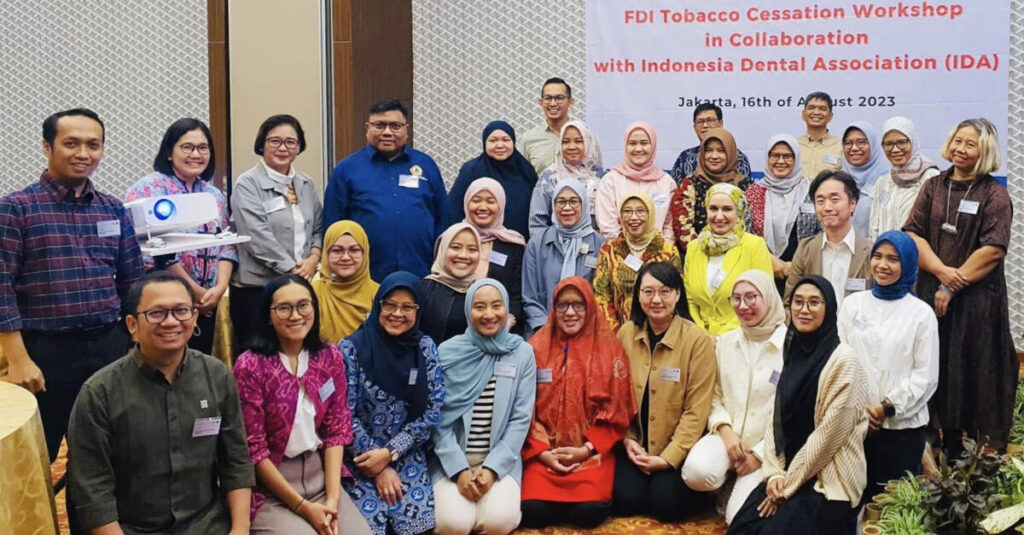
The pilot project has grown into a global initiative. From 2021 to 2025, seminars have reached 18 countries and territories, training over 1,100 participants — dentists, hygienists, educators, and other oral health professionals. Events were held in countries of Africa, the Middle East, Europe, and Latin America, demonstrating the truly global nature of the initiative.
Recent research confirms the effectiveness of the program. A study in Nigeria that examined structured training in the 5As and 5Rs models revealed significant improvement in both knowledge and self-assessed clinical practice of oral health professionals following participation in FDI-supported training.
Feedback from participants consistently indicates increased motivation and willingness to discuss tobacco smoking with patients. Many noted that the training helped them view tobacco cessation counseling as an integral component of dental care, rather than an additional or secondary activity, which facilitates the integration of this intervention into routine appointment protocols.
Scaling up: electronic cigarettes and vaping
As the project has evolved, priorities have been identified for further training: relapse prevention strategies; recommendations for working with youth engaged in vaping; and adaptation of interventions to different cultural contexts. As behavior regarding tobacco and nicotine changes, the FDI is preparing to scale up the project to address the growing prevalence of electronic cigarettes and vaping products, particularly among youth. A recent article in the International Dental Journal emphasizes the importance of preparing dentists to address vaping and electronic cigarette use in clinical practice.
Session at FDI World Dental Congress 2026
At the congress in Prague (September 4–7, 2026), the FDI will conduct a special session “Tobacco cessation and novel nicotine-containing products: evidence-based strategies to strengthen the dental team.” The session will focus on advancing brief intervention skills, reviewing the latest data on vaping, and equipping teams with practical resources needed to effectively work with patients using various forms of nicotine-containing products.
We use cookies to improve website performance, analyze traffic, and personalize content. You can accept all cookies or customize their use. Learn more in our Cookie Policy.
Functional
Always active
Technical storage or access is strictly necessary for the legitimate purpose of making possible the use of a particular service expressly requested by the subscriber or user, or solely for the purpose of carrying out the transmission of a message over an electronic communications network.
Preferences
The technical storage or access is necessary for the legitimate purpose of storing preferences that are not requested by the subscriber or user.
Statistics
Technical storage or access used solely for statistical purposes.The technical storage or access that is used exclusively for anonymous statistical purposes. Without a subpoena, voluntary compliance on the part of your Internet Service Provider, or additional records from a third party, information stored or retrieved for this purpose alone cannot usually be used to identify you.
Marketing
Technical storage or access is necessary to create user profiles for the purpose of sending advertising or to track a user across a website or multiple websites for similar marketing purposes.