Main » New in Dentistry » Expanding the Digital Ecosystem: Integration of the DEXIS Imprevo Scanner into the Nobel Biocare Portfolio
Expanding the Digital Ecosystem: Integration of the DEXIS Imprevo Scanner into the Nobel Biocare Portfolio
Digital dentistry continues to develop rapidly, offering new tools and approaches that significantly change the daily practice of clinicians. One of the most significant trends in recent years has been the formation of a comprehensive digital workflow capable of covering all key stages — from diagnosis to treatment planning and final tooth restoration. Such integrated solutions help to improve the accuracy, speed, and predictability of outcomes, which is especially important in restorative and implantology practice.
In this global picture of innovation, a special place is occupied by the DTX Studio Clinic platform from Nobel Biocare — a powerful software solution for planning and coordinating digital procedures. However, for any digital workflow to be truly complete, it needs data collection tools — primarily accurate and fast intraoral scanners. At the beginning of 2026, Nobel Biocare made a strategic move by expanding its digital portfolio with a new device — the DEXIS Imprevo scanner. This decision strengthens the end-to-end workflow, allowing this tool to be combined with a powerful analytical and planning platform.
Conceptual Foundations of the Partnership: Why Imprevo?
Strengthening the Digital Ecosystem
The integration of the DEXIS Imprevo into the Nobel Biocare digital portfolio aims to create a more cohesive and continuous workflow, in which digital data from scanning is directly used for diagnosis, planning, and fabrication of restorations and implants. Such synergy helps eliminate traditional gaps between stages, reducing the likelihood of information loss and increasing the accuracy of the treatment plan.
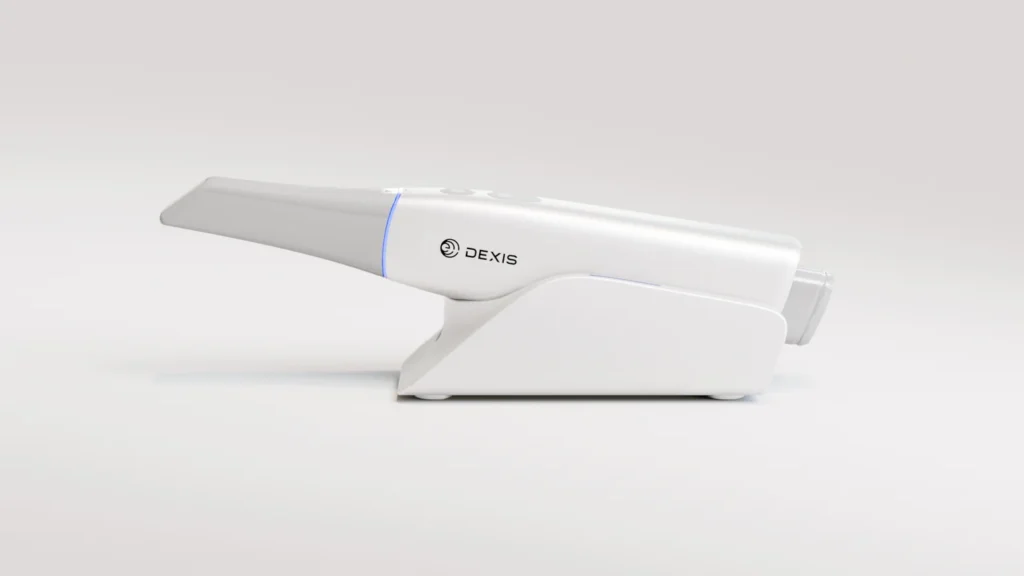
The Imprevo scanner is not just another data input device; it is designed with an emphasis on speed, ergonomics, and clinical flexibility. This is reflected in several key aspects of its design and technical specifications.
The DEXIS Imprevo intraoral scanner integrates with DTX Studio Clinic software to support digital workflows
Technical Features of the DEXIS Imprevo
A crucial advantage of the Imprevo is its data capture speed: the device is capable of recording up to 40 frames per second, which is approximately double the rate of the previous IS 3800 scanner series. Thanks to this capture speed, the clinician obtains a denser and more detailed three-dimensional representation of the areas relevant to treatment, which simplifies the assessment of the clinical picture and, if necessary, accelerates work on the subsequent stages of the treatment plan.
From a practical application standpoint, the Imprevo offers a slimmer handpiece — 20% slimmer compared to standard models from previous series. This improvement not only makes the doctor’s work easier but also increases patient comfort, especially during prolonged scans of complex anatomical areas.
Another important technical parameter is the increased Depth of Field, up to 25 mm, which is approximately 39% greater than the previous line of devices. This provides better visualization of deep prepared areas and interproximal spaces, especially in complex clinical scenarios of restorative or implant preparation.
Support for direct integration with DTX Studio Clinic means that data obtained by the scanner can be used immediately for visualization, treatment planning, and communication with the patient — without the need for manual transfer. This makes the workflow smoother and minimizes the risk of errors during information transfer.
Strategic Importance for Clinical Practice
With the introduction of the Imprevo, Nobel Biocare strengthens its status as a provider of end-to-end digital solutions — from anatomical data collection to final reconstruction. This is especially important for implantologists and specialists in restorative dentistry, where the accuracy of planning directly affects the longevity and aesthetics of the result.
A comprehensive digital workflow reduces the number of stages requiring manual data processing, helps automate documentation, and accelerates clinical decision-making. As a result, clinics achieve more predictable outcomes and can increase productivity without compromising quality — which is especially relevant in the context of increasing practice workload and patient expectations regarding the speed and accuracy of treatment.
Prospects and Conclusions
The expansion of the Nobel Biocare digital portfolio with the DEXIS Imprevo reflects a broader industry trend: the transition from fragmented digital tools to fully integrated solutions capable of covering the entire lifecycle of dental treatment. Such solutions allow dental practices to build more reliable, transparent, and flexible processes that improve work efficiency and the quality of interaction with patients.
The integration of advanced scanning technologies with powerful planning platforms is not just a technological step, but a strategic contribution to the future of dentistry. In combination with other digital tools, this paves the way for more accurate restorations, reduced data processing time, and improved predictability of clinical outcomes.
In the long term, such integrated digital solutions will become the standard of practice, especially for specialists working with complex cases of restorative or implant therapy. Nobel Biocare’s initiative in this direction not only strengthens its role as an industry leader but also stimulates broader adoption of digital technologies among clinicians worldwide.
The global dental industry continues to experience pressure from market consolidation, digital transformation, and demand for reproducible clinically validated solutions
We use cookies to improve website performance, analyze traffic, and personalize content. You can accept all cookies or customize their use. Learn more in our Cookie Policy.
Functional
Always active
Technical storage or access is strictly necessary for the legitimate purpose of making possible the use of a particular service expressly requested by the subscriber or user, or solely for the purpose of carrying out the transmission of a message over an electronic communications network.
Preferences
The technical storage or access is necessary for the legitimate purpose of storing preferences that are not requested by the subscriber or user.
Statistics
Technical storage or access used solely for statistical purposes.The technical storage or access that is used exclusively for anonymous statistical purposes. Without a subpoena, voluntary compliance on the part of your Internet Service Provider, or additional records from a third party, information stored or retrieved for this purpose alone cannot usually be used to identify you.
Marketing
Technical storage or access is necessary to create user profiles for the purpose of sending advertising or to track a user across a website or multiple websites for similar marketing purposes.