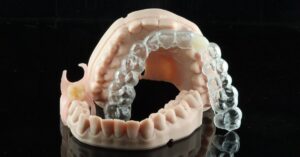
Clinical case and baseline data
A 55-year-old female patient presented with a desire to restore missing teeth using fixed implant-supported restorations, excluding removable options. Clinical examination revealed severe periodontal disease and generalized tooth mobility grade III. An asymptomatic periapical lesion was noted on tooth #30. Visual analysis showed significant attrition of the lower anterior teeth, while vertical occlusal height remained within normal limits, and the smile line was moderate.


Treatment options were discussed: implant-supported crowns and bridges, or a full implant-supported rehabilitation of both jaws. The patient agreed to the second option, involving a digital workflow from planning to final prosthesis placement.

Digital workflow
The treatment was conducted using a fully digital approach, which included:
- Digital Smile Design – creating an aesthetic model for the future restoration.
- Integration of CBCT and intraoral scanning – merging 3D data for precise surgical planning.
- Implant planning with guided surgery – placement of six implants in the upper jaw and four implants in the lower jaw.
- Immediate prosthetics – placement of temporary hybrid prostheses the day after surgery using ceramic-hybrid resin.
- Final restoration – after three months of implant healing, the prostheses were replaced with a titanium framework with zirconia overlays, fabricated based on prototypes and verified directly at the patient’s chair.

Results and patient satisfaction
The patient reported a high level of satisfaction with the aesthetics and functionality of the restorations. The restoration not only restored masticatory efficiency but also boosted self-confidence, which is an important aspect of comprehensive dental rehabilitation.


Advantages of modern materials and technologies
Digital integration of CBCT, intraoral scanning, and guided surgery enables highly accurate implant placement and prosthesis fabrication. The use of zirconia provides durability, high aesthetics, and biocompatibility. Modern workflows facilitate immediate implant loading, minimizing the time intervals between surgery and functional restoration.
Customization and long-term perspectives
The choice between preserving natural teeth and implant-supported rehabilitation requires comprehensive evaluation: dental history, comorbidities, financial capabilities, and patient expectations. The long-term survival rate of modern implant-supported restorations reaches 90–98% over 10–15 years. However, the clinician must consider the risks of peri-implantitis and technical complications.
Conclusion
Современные цифровые технологии и прогрессивные материалы радикально изменили подход к полной имплантной реабилитации обеих челюстей. Интеграция протетически ориентированного планирования, немедленной нагрузки и точных хирургических протоколов повышает точность, предсказуемость и качество лечения, обеспечивая восстановление не только функции, но и психологической уверенности пациента.