Main » New in Dentistry » A New Era in Teen Orthodontics: Innovative Invisalign System for Correcting Overbite Now Available in Singapore
A New Era in Teen Orthodontics: Innovative Invisalign System for Correcting Overbite Now Available in Singapore
In July 2025, Align Technology introduced its latest innovation in Singapore – the Invisalign system with mandibular advancement functionality and integrated occlusal blocks. This technology aims to comprehensively correct skeletal and dental Class II anomalies in growing patients, combining functional impact on the maxillofacial apparatus with the aesthetics of clear aligners. This solution represents a significant milestone in the evolution of digital orthodontics, particularly for patients aged 10 to 16 years.
Relevance of the Problem
Class II malocclusions, characterized by an underdeveloped lower jaw positioned retrusively relative to the upper jaw, represent one of the most common orthodontic pathologies. Statistically, they account for 30–45% of all global malocclusion cases. The consequences of these anomalies extend beyond mere aesthetic concerns—they can lead to difficulties in chewing, impaired speech, uneven stress distribution on the dentofacial system, and even psychological discomfort during adolescence.
Traditional treatment approaches involve multi-stage use of functional appliances and brace systems. However, these methods often require extended time, high patient motivation, and can cause discomfort. In the context of modern orthodontics, there is a demand for solutions that combine effectiveness, convenience, and predictability of results.
The Essence of the Innovation: An Integrated Approach in a Single System
The presented Invisalign system combines two key functional elements:
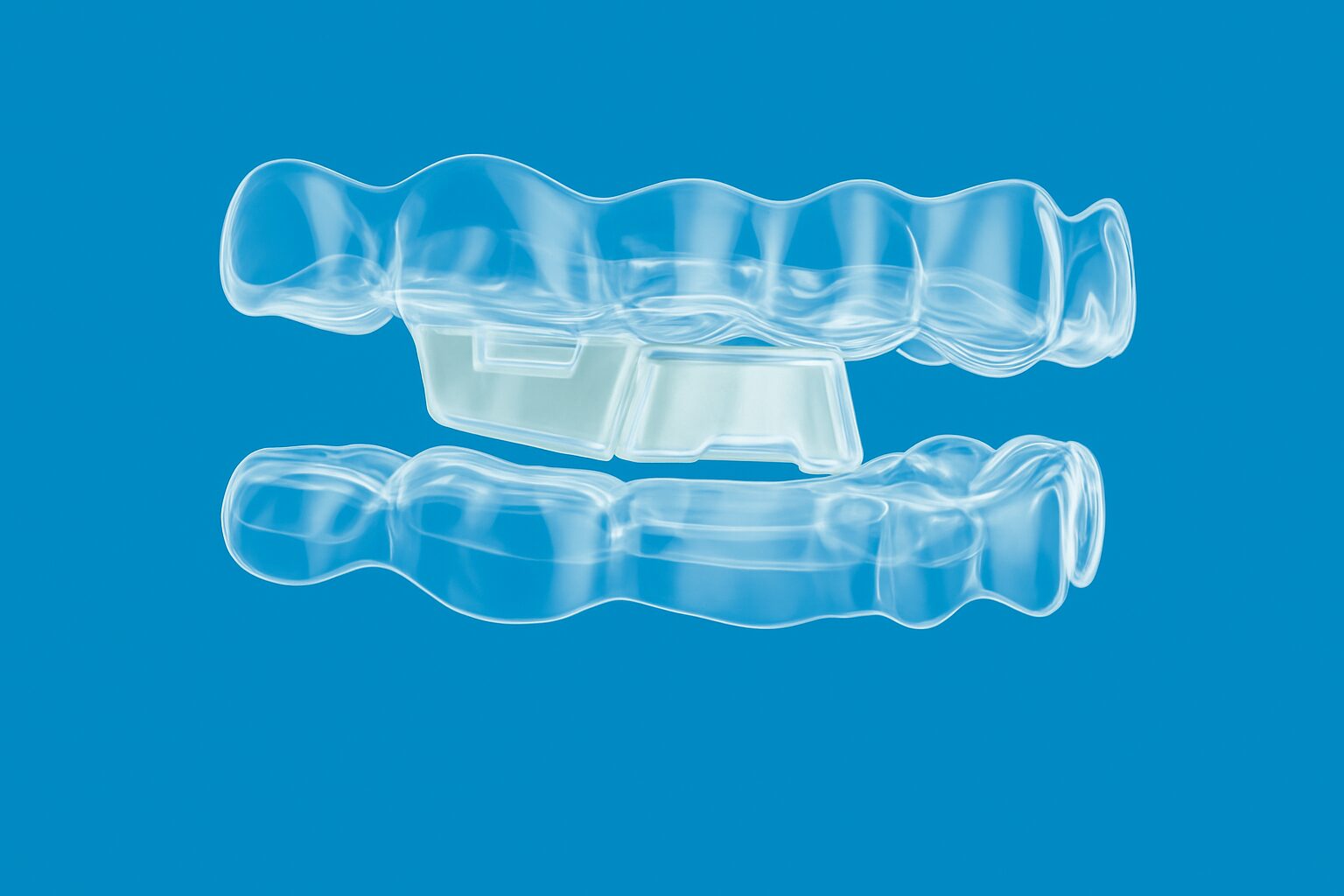
The mandibular advancement function promotes its gradual forward positioning, utilizing the patient’s natural growth during the period of active bone structure formation.
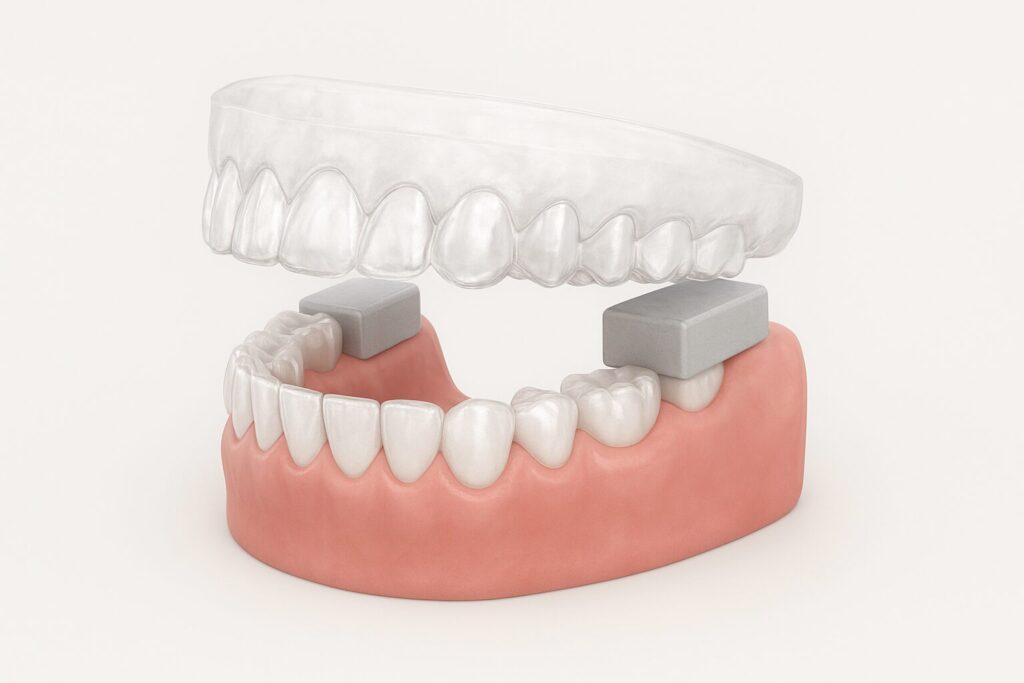
Integrated occlusal blocks provide vertical separation of the dental arches and stable fixation, enabling the initiation of the functional treatment phase at earlier stages, including cases of deep bite and Class II, division 2.
These blocks are manufactured using laser welding, which gives them high strength and durability throughout the entire course of treatment.
Fig. 1. The Invisalign system with mandibular advancement and occlusal blocks, designed for the treatment of Class II malocclusion in patients during the active growth phase, addressing mandibular retrusion through a comprehensive solution utilizing clear aligners.
Clinical Features and Advantages
Unified therapeutic concept. Unlike the traditional approach, which may involve multiple orthodontic appliances, the new system allows for simultaneous correction of jaw position and tooth alignment.
Comfort and treatment adherence. The use of the proprietary SmartTrack™ material reduces the sensation of pressure and enhances wearing comfort, which is particularly important for adolescents who may be prone to reduced compliance when using uncomfortable appliances.
High predictability of results. The system combines SmartTrack (material), SmartForce (biomechanical elements), and SmartStage (step-by-step planning), ensuring controlled and gradual tooth movement. The ability to place attachments even beneath occlusal blocks prevents unwanted shifts.
Age Group and Treatment Strategy
The system is designed for children and adolescents aged 10–16 years in the late mixed dentition stage or early permanent dentition phase. It is during this period that the body retains high growth potential, allowing for intervention not only in tooth position but also in the harmonious development of the jaws and facial profile.
Expert Opinion
According to Sriram Lakshmi Kolli, Executive Vice President and Chief Product and Digital Officer of Align Technology, this development demonstrates the continued expansion of Invisalign’s capabilities and strengthens the position of clear aligners in the functional orthodontic treatment segment.
Dr. Mitra Derakhshan, Executive Vice President and Chief Clinical Officer of the company, emphasizes that the integration of occlusal blocks enhances the effectiveness of mandibular advancement and bite opening, making the solution versatile for a wide range of cases.
Geography of Implementation
Singapore has become one of the first markets where this technology is available. In addition to Singapore, the system is already available in Australia, New Zealand, Japan, Hong Kong, and India. Expansion to other Asia-Pacific countries is planned for the end of 2025. The new product complements the portfolio of solutions for growing patients, including the Invisalign Palatal Expander System and Invisalign First.
Conclusion
The introduction of the Invisalign system with mandibular advancement function and occlusal blocks reflects a global trend of integrating digital technologies and functional orthodontics. This solution not only enhances the efficiency and convenience of treatment but also enables doctors to influence key growth parameters of the craniofacial complex during the most favorable period of patient development.
Given the high prevalence of Class II malocclusions, such technologies have the potential to significantly transform approaches to adolescent orthodontic treatment, achieving a balance between functional, aesthetic, and psychological outcomes.
Modern dentistry is developing under conditions of rapid growth in clinical capabilities. New materials, digital technologies, imaging methods, and treatment
The global dental industry is undergoing an intensive digital and technological transformation requiring new cooperation between clinical, industrial and educational
We use cookies to improve website performance, analyze traffic, and personalize content. You can accept all cookies or customize their use. Learn more in our Cookie Policy.
Functional
Always active
Technical storage or access is strictly necessary for the legitimate purpose of making possible the use of a particular service expressly requested by the subscriber or user, or solely for the purpose of carrying out the transmission of a message over an electronic communications network.
Preferences
The technical storage or access is necessary for the legitimate purpose of storing preferences that are not requested by the subscriber or user.
Statistics
Technical storage or access used solely for statistical purposes.The technical storage or access that is used exclusively for anonymous statistical purposes. Without a subpoena, voluntary compliance on the part of your Internet Service Provider, or additional records from a third party, information stored or retrieved for this purpose alone cannot usually be used to identify you.
Marketing
Technical storage or access is necessary to create user profiles for the purpose of sending advertising or to track a user across a website or multiple websites for similar marketing purposes.