Main » Uncategorized » Robotic precision in autotransplantation of teeth: multi-axis system and transformation of maxillofacial surgery
Robotic precision in autotransplantation of teeth: multi-axis system and transformation of maxillofacial surgery
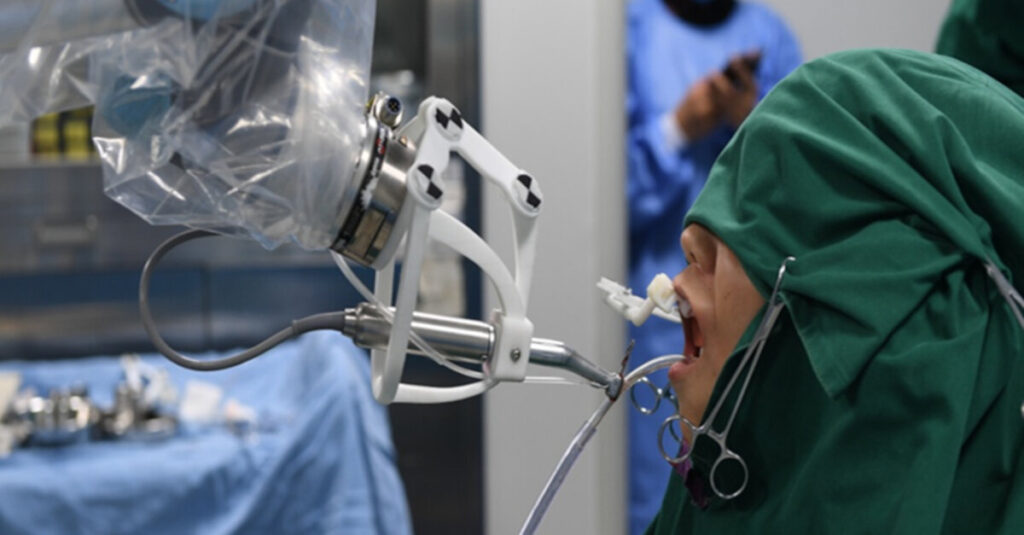
Chinese researchers demonstrated that an autonomous robotic system is capable of reproducing complex root morphology better than traditional surgical approach. This opens new perspectives not only for tooth autotransplantation, but also for the entire maxillofacial surgery.
Clinical significance of autotransplantation and problems of traditional approach
Tooth autotransplantation is a procedure requiring maximum precision. Extraalveolar time (the time the tooth spends outside the socket) and periodontal contact — the density of root fit to the alveolar walls — critically influence the outcome. However, preparation of the alveolus for a donor tooth is complicated by unpredictable root morphology, especially in multi-rooted teeth with bifurcations.
Previous robotic solutions in dentistry operated along linear trajectory, suitable for implant osteotomy, but unable to adapt to three-dimensional geometry of the root. A team of scientists from Xi’an under the leadership of Professor Shizhu Bai (Air Force Medical University) developed a multi-axis system capable of performing non-linear osteotomic paths.
Research methodology
The experimental study used 40 three-dimensionally printed models of the mandible. Half underwent robotic alveolus preparation, half underwent preparation using static surgical template. Each group contained ten single-rooted and ten two-rooted anatomical variants.
Software positioned the donor tooth and projected the target alveolus geometry. Results showed clear advantage of the robot: lesser average deviation at the root apex, lower angular deviation, and significantly higher volumetric correspondence to the planned geometry. Differences were particularly notable in two-rooted cases.
Role of biomechanics and excessive resection when using static templates
The most significant result concerned the volume of bone resection. When using static template, surgeons removed more bone than planned, compensating for morphology complexity with additional fitting and adaptation. The robot, however, avoided this cycle of repeated cutting, operating exclusively according to the calculated plan while maintaining the same procedure time.
Professor Bai explained: when a surgeon visually assesses complex anatomy (concavities, bifurcations, interradicular bone), his cognitive load approaches the limit. The robot processes these variables without difficulty, relying exclusively on pre-calculated geometric parameters.
Prospects of autonomous robotics in maxillofacial surgery
The study symbolizes a broader shift in maxillofacial surgery: from a craft dependent on tactile sensitivity and experience, to precision execution guided by geometric calculations and trajectory planning.
The authors note that complex non-linear movements of a multi-axis system may be required in tooth preparation for crown, osteoplasty in crown lengthening, and removal of impacted teeth.
Professor Bai expressed a vision of the future: «The competitive advantage of dentists of tomorrow will be determined not by a steady hand, but by the quality of preoperative planning. By delegating physical execution to machines, specialists will be able to focus on diagnosis, biological aspects, and patient care».
Directions of future research
Clinical studies are necessary to prove whether improvements in geometric accuracy translate into reduction of extraalveolar time and increased graft survival rate. These experimental results serve as a foundation for translation of the technology into clinical practice and assessment of its impact on long-term outcomes.
We use cookies to improve website performance, analyze traffic, and personalize content. You can accept all cookies or customize their use. Learn more in our Cookie Policy.
Functional
Always active
Technical storage or access is strictly necessary for the legitimate purpose of making possible the use of a particular service expressly requested by the subscriber or user, or solely for the purpose of carrying out the transmission of a message over an electronic communications network.
Preferences
The technical storage or access is necessary for the legitimate purpose of storing preferences that are not requested by the subscriber or user.
Statistics
Technical storage or access used solely for statistical purposes.The technical storage or access that is used exclusively for anonymous statistical purposes. Without a subpoena, voluntary compliance on the part of your Internet Service Provider, or additional records from a third party, information stored or retrieved for this purpose alone cannot usually be used to identify you.
Marketing
Technical storage or access is necessary to create user profiles for the purpose of sending advertising or to track a user across a website or multiple websites for similar marketing purposes.