
Advancement of materials for dental 3D printing significantly expands the possibilities for manufacturing personalized temporary restorations and prosthodontic constructions directly in the clinic. The range of applications includes both temporary and permanent fixed prostheses, removable dentures, surgical guides, custom trays, and aligners — however, the principal advantage remains the speed of fabrication, unattainable with subtractive methods.
Clinical Potential and Materials Science Aspects
The implementation of CAD/CAM technologies in dentistry is oriented toward increasing work efficiency and reducing costs without compromising treatment quality. Nevertheless, data on 3D-printed materials remain incomplete: in vitro studies reveal material-dependent differences in surface hardness, impact resistance, and flexural strength between digital and traditional prosthetic base fabrication. This points to the critical role of material selection and post-processing in evaluating new solutions.
Clinical Example: Temporary Partial Removable Denture
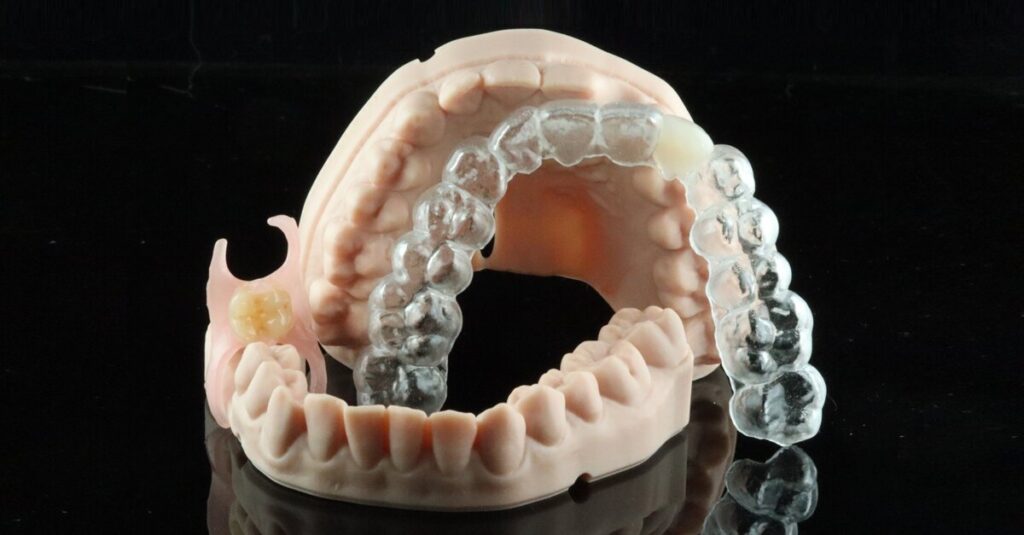
A 25-year-old patient with missing tooth #36 was planned for implantation, but temporary restoration was required until completion of osseointegration. A flexible partial removable denture was fabricated: the base and crown were designed separately in Medit Design, with the molar anatomy reproduced by mirror imaging of the contralateral antagonist. It was noted that prolonged alcohol treatment reduces the adhesion strength between the printed material and cement, therefore a spirit-free cleanser was used. Components were fixed with dual-cure cement, followed by light polymerization and final polymerization before delivery to the patient.
Provisional Retainer as a Backup
Upon extraction of tooth #22 with simultaneous implantation in a 38-year-old patient, a 3D-printed retainer was fabricated in advance in case primary implant stability would not be achieved. This precautionary measure is particularly relevant, as long-term biocompatibility data on printed aligners and retainers remain limited, although such constructions demonstrate improved accuracy compared to thermoformed analogs. The retainer was designed with a thickness of 0.8 mm and allowances of 0.1 mm, with supports placed only at the margins according to manufacturer guidelines. After printing and final polymerization in a protective nitrogen atmosphere, a composite pontic was formed on the occlusal surface to restore esthetics during the transitional period.
Conclusion
Despite progress in materials and software, the basic principles of tooth restoration remain unchanged — only the methods of their implementation are transformed. Both described cases demonstrated that simple CAD software and in-office 3D printing provide quality results in comparatively non-standard clinical situations, opening prospects for further optimization of workflows and treatment outcomes.