Main » Uncategorized » Article text: Lucitone Digital Print Denture: 16 shades and transformation of aesthetics, predictability and clinical effectiveness
Article text: Lucitone Digital Print Denture: 16 shades and transformation of aesthetics, predictability and clinical effectiveness
Digitalization and additive technologies are radically transforming the dental industry, forming new production and clinical development paradigms.
The key challenge remains the predictability, aesthetics and reproducibility of prostheses while simultaneously reducing time and barriers to adoption; Dentsply Sirona and HeyGears announced the validation of materials Lucitone Digital Print Denture for single-unit printed production on the printer UltraCraft MMF, integrating design and printing. This material presents an analytical review of the workflow validation and a discussion of the clinical and production implications based on the principles of evidence-based medicine.
Integration as a key factor
The integration of materials, equipment and digital protocols provides the most important level of control over the quality of finished structures — from digital scanning and CAD-modeling to printing parameters and post-processing. The joint validation by Lucitone and HeyGears is aimed not only at confirming the mechanical strength and wear resistance of the material, but also at optimizing the anatomy of restorations, preserving tooth morphology and adequate occlusal relationships, which is critical for occlusion balancing and reducing the risk of functional complications.
Assessment of morphology and occlusion
Workflow verification includes assessment of the accuracy of reproduction of crown morphology, the magnitude of interalveolar height and contacts in static and dynamic occlusion; control of these parameters reduces the need for clinical adjustments, decreases micro-mobility of the base and minimizes retention areas for bacterial biofilm, which has a direct impact on the prognosis of soft tissue adaptation.
Manufacturing process: single cycle and advantages
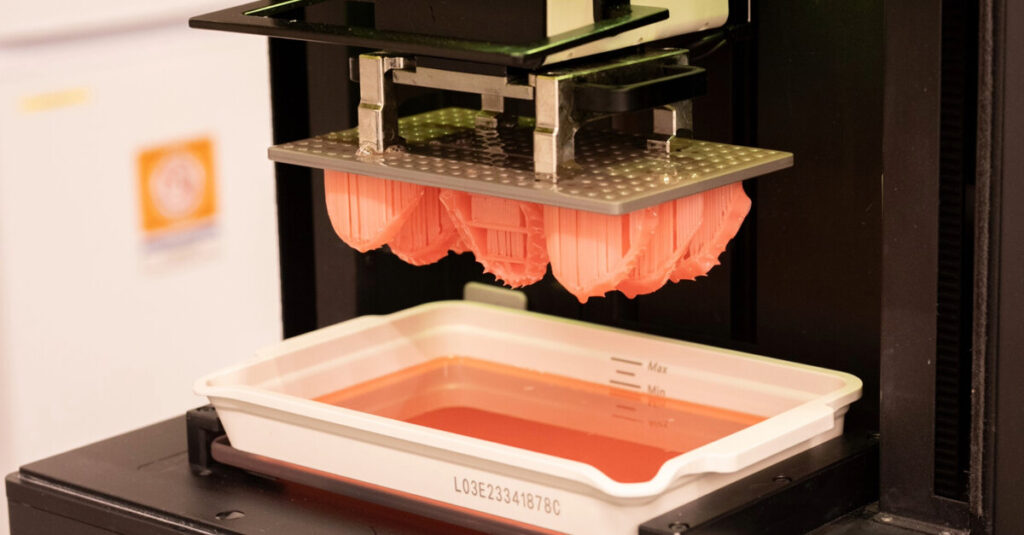
The transition to a single print cycle reduces the number of manual processing steps, accelerates the release of restorations and increases reproducibility; maintaining a seamless interface between the base and the crown anatomy reduces the number of microcracks and weak areas, which positively affects durability and reduces the risk of delamination. The Lucitone shade system — 16 shades A1–D4, two bleaching tones and five gingival shades — expands the possibilities for aesthetic personalization without significant increase in technological complexity.
Manufacturing parameters and software
The quality of the final product is determined not only by the chemical and mechanical characteristics of the material, but also by equipment calibration, polymerization regimes and algorithms for model preparation in preprocessing software; the HeyGears software package provides control of printing parameters, layer verification and predictive assessment of contacts, which contributes to the standardization of processes in laboratory conditions.
Clinical and biological aspects: biocompatibility and tissues
Long-term biocompatibility and the effect of printed materials on soft tissue regeneration are subjects of clinical interest; the assessment includes cytotoxicity, monomer release, resistance to crack formation and microstructural stability under conditions of saliva and mechanical loading. An interdisciplinary approach implies conducting controlled clinical studies and long-term patient follow-up to confirm safety and clinical efficacy.
Implications for clinical practice
For the dentist, the transition to integrated digital workflows means the need to revise planning and verification protocols: confirmation of occlusal contacts on the articulator and in the oral cavity, assessment of base fit, regular monitoring of the condition of peripheral tissues — all this requires adaptation of clinical algorithms and staff training in order to achieve predictable results.
Conclusion
Lucitone Digital Print Denture demonstrates the development of modern dentistry as an integrated digital ecosystem, where the combination of materials with verified properties, high-precision equipment and specialized software provides more predictable, aesthetic and reproducible prosthetics; at the same time, further clinical studies are necessary to confirm long-term biocompatibility and to assess treatment outcomes in a broad patient population.
We use cookies to improve website performance, analyze traffic, and personalize content. You can accept all cookies or customize their use. Learn more in our Cookie Policy.
Functional
Always active
Technical storage or access is strictly necessary for the legitimate purpose of making possible the use of a particular service expressly requested by the subscriber or user, or solely for the purpose of carrying out the transmission of a message over an electronic communications network.
Preferences
The technical storage or access is necessary for the legitimate purpose of storing preferences that are not requested by the subscriber or user.
Statistics
Technical storage or access used solely for statistical purposes.The technical storage or access that is used exclusively for anonymous statistical purposes. Without a subpoena, voluntary compliance on the part of your Internet Service Provider, or additional records from a third party, information stored or retrieved for this purpose alone cannot usually be used to identify you.
Marketing
Technical storage or access is necessary to create user profiles for the purpose of sending advertising or to track a user across a website or multiple websites for similar marketing purposes.