Main » New in Dentistry » 4D Workflow FKG: 4 components and transformation of predictability of endodontic care
4D Workflow FKG: 4 components and transformation of predictability of endodontic care
In the era of rapid digitalization modern dentistry is developing as one of the most dynamic fields of medical science, requiring the integration of technologies and clinical expertise.
In these conditions a key factor of progress becomes not only the development of new tools but also the effective translation of workflows into clinical practice, which underlies the concept of the 4D Workflow from FKG Dentaire.
Brief characteristics and clinical aim
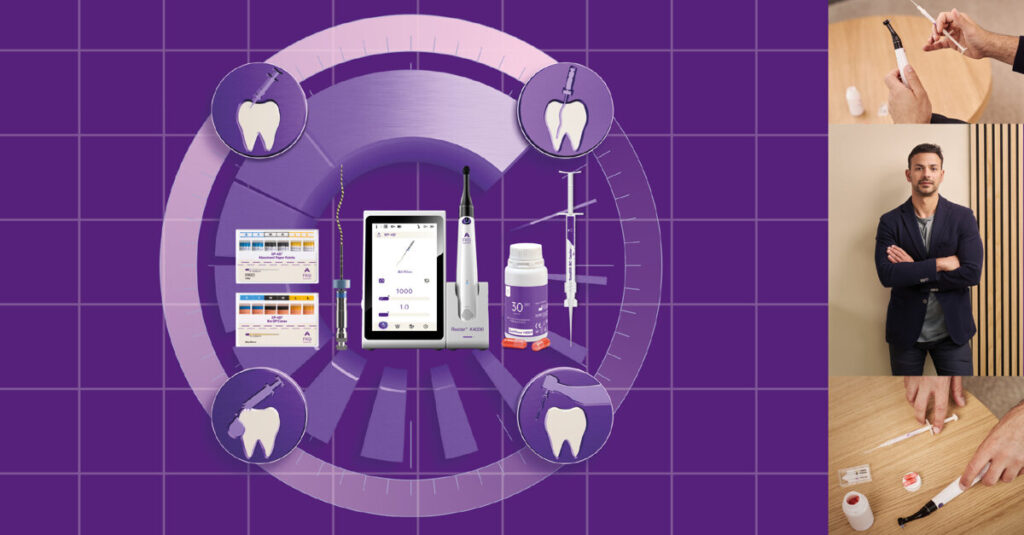
4D Workflow represents an integrated system combining the stages of shaping, the use of the motor platform, irrigation and obturation with the aim of simplifying and standardizing endodontic procedures. The target task is to increase the predictability of clinical outcomes while simultaneously reducing operating time and decreasing technique variability between practitioners.
Components of 4D Workflow: structure and functionality
XP‑4D — canal shaping
XP‑4D is designed to adapt to the anatomy of the root canal due to the dynamic flexibility of the working tip, which minimizes stress on dentin and on the instrument. Such shaping is aimed at achieving predictable taper and smooth canal walls while reducing the risk of residual infected tissue in curved canals.
Rooter X4000 — motor platform and digital integration
Rooter X4000 functions as a motor with a built‑in apex locator, a touch interface and presets for standardized protocols. The ability to synchronize software allows updating work cycles and adapting parameters to a given clinical protocol, which increases reproducibility of the procedure and simplifies documentation.
Dual Rinse HEDP — irrigation solution
Dual Rinse HEDP combines chelating properties and antiseptic activity in a single solution, which potentially reduces the number of manipulations and contributes to decreased instrument wear. The usage protocol is oriented towards compatibility with mechanical canal preparation and stages of final disinfection prior to obturation.
TotalFill — bioceramic obturation
The bioceramic TotalFill system is positioned as a material for long‑term and biocompatible sealing with a single‑cone technique. Validation of TotalFill within more than 120 independent studies emphasizes the importance of standardizing obturation technique and adherence to evidence‑based medicine.
Clinical validation and practical significance
The integration of components into a single protocol is aimed at reducing the number of variable factors, which facilitates the conduct of multicenter studies and clinical validation. Standardized presets and predefined work sequences simplify training and increase interoperator consistency.
Expert comment: The implementation of a unified ecosystem allows a systematic approach to the assessment of treatment outcomes (for example, evaluation of seal integrity, rate of healing of periradicular tissues and frequency of complications), however continuation of independent clinical studies with long‑term follow‑up is required to confirm superiority in clinical endpoints.
Organizational and educational aspects of implementation
The Swiss manufacturing base of FKG Dentaire and its history as a center of micro‑technologies create a stable platform for disseminating standardized protocols. Important organizational elements are:
systematic staff training and modular educational programs;
software and update synchronization for uniform application of protocols;
integration of digital documentation for quality audit and clinical research;
adaptation of protocols to the specifics of the clinical environment and regulatory requirements of different countries.
Advantages and limitations
Key advantages of 4D Workflow include process standardization, savings in operating time, reduction of operator variability and simplification of training. However limiting factors include the need for initial capital investment, adaptation of clinic workflows and the need to accumulate independent clinical data in different patient populations.
Recommendations for clinical integration
conduct a pilot implementation with subsequent analysis of outcomes and quality indicators;
ensure documentation of working parameters and sterilization standards for reproducibility of protocols;
include training on the motor platform and materials in the clinic’s continuing education program;
participate in registry studies or multicenter trials to accumulate objective data.
Conclusion
4D Workflow demonstrates a shift in endodontic practice from a set of individual products to an integrated ecosystem where a digital platform, unified protocols and biocompatible materials interact to increase predictability and efficiency of treatment. For clinicians it is important to maintain a critical approach during implementation, combining innovations with thorough validation and monitoring of clinical outcomes.
Digitalization and additive technologies are radically transforming the dental industry, forming new production and clinical development paradigms. The key challenge
We use cookies to improve website performance, analyze traffic, and personalize content. You can accept all cookies or customize their use. Learn more in our Cookie Policy.
Functional
Always active
Technical storage or access is strictly necessary for the legitimate purpose of making possible the use of a particular service expressly requested by the subscriber or user, or solely for the purpose of carrying out the transmission of a message over an electronic communications network.
Preferences
The technical storage or access is necessary for the legitimate purpose of storing preferences that are not requested by the subscriber or user.
Statistics
Technical storage or access used solely for statistical purposes.The technical storage or access that is used exclusively for anonymous statistical purposes. Without a subpoena, voluntary compliance on the part of your Internet Service Provider, or additional records from a third party, information stored or retrieved for this purpose alone cannot usually be used to identify you.
Marketing
Technical storage or access is necessary to create user profiles for the purpose of sending advertising or to track a user across a website or multiple websites for similar marketing purposes.