Main » Uncategorized » Milling and additive technologies: at the scale of clinics and laboratories and transformation of clinical validation
Milling and additive technologies: at the scale of clinics and laboratories and transformation of clinical validation
Modern dentistry is undergoing a rapid digital transformation, integrating CAD/CAM technologies into clinical and laboratory workflows, increasing efficiency.
CAD/CAM and associated digital workflows — scanning, virtual design, milling and 3D‑printing — are shaping a new paradigm for the fabrication of restorations; the choice between additive and subtractive technologies should be based on evidence-based medicine, biological criteria and clinical indications, and not solely on speed or convenience.
Durability as a key factor
Clinical practice requires restorations with predictable longevity and stable esthetics; long-term clinical validation of ceramic materials provides a high level of confidence among clinicians and serves as a guide when making decisions in favor of definitive restorations.
Clinical validation and long-term outcomes
Long-term studies show survival of restorations made from lithium disilicate and zirconia materials exceeding 90 percent at 10 years; these data are important when assessing risk of fracture, marginal stability and plaque accumulation — parameters that directly affect periodontal and functional outcomes. An expert approach implies considering not only static strength metrics but also results of cyclic loading, wear resistance and clinical adaptation to antagonists.
Material and its decoding
The optimal choice of material is determined by the combination of mechanical properties, biocompatibility and technological processing requirements; understanding the differences between polycrystalline ceramics and composite/resin systems is critical for indication selection.
Mechanical properties and biosafety
Flexural strength — a key parameter: hybrid 3D‑printable resins with ceramic filler (>50% by mass) demonstrate flexural strength on the order of 80–150 МПа, whereas lithium disilicate blocks — about 500 МПа, and high-strength zirconia frameworks — up to 1 200 МПа; these numerical relationships determine indications for use depending on restoration location and occlusal load. Biocompatibility is critical — the presence of reactive monomers and unpolymerized components requires strict control of post-polymerization, validation of elution of substances and documented assessment of cytotoxicity and sensitization.
Productivity as a key factor
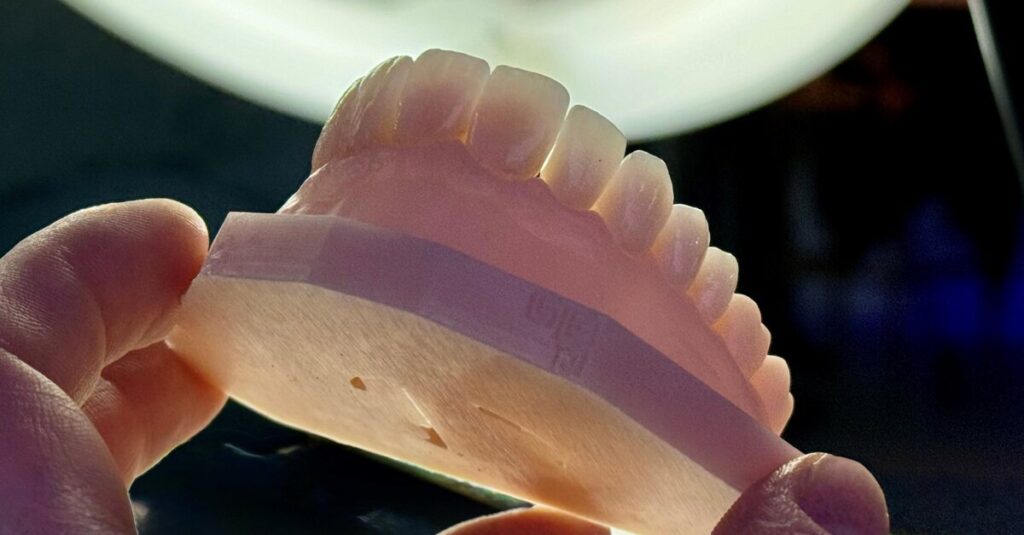
Additive technologies significantly accelerate the production of diagnostic models, surgical guides and provisional restorations, which improves clinic and laboratory logistics; however, for definitive restorations it is necessary to compare productivity with the durability and safety of materials.
Integration into the digital ecosystem and clinical cooperation
3D‑printing facilitates synchronization of data between the clinic and the laboratory, reducing communication time and increasing the accuracy of guides for navigational surgery and regeneration planning; to achieve reproducible results interdisciplinary cooperation is necessary — engineers and technicians must work closely with the clinician to standardize printing parameters, post-processing and quality control.
Practical recommendations and standardization
When deciding on the fabrication method for a restoration, it is recommended to follow indications: for definitive fixed restorations under high occlusal loads give preference to materials with proven durability — all-ceramic or monolithic zirconia, for provisional restorations and some individualized cases — use certified additive systems with a validated post-polymerization protocol; clinical protocols should include control of internal and marginal fit, measurement of surface roughness, assessment of wear and biocompatibility. Important elements of implementation are documented SOPs for post-polymerization, regular equipment validation, quality control standards and participation in international educational initiatives — symposia and courses raise competencies and accelerate the exchange of evidence.
In conclusion, milling and 3D‑printing are not mutually exclusive technologies; a modern clinical strategy should rely on the integration of methods, selection of material according to indications, strict post-processing and clinical validation, which will allow combining the expediency of digital protocols with predictable longevity and patient safety.
Modern restorative dentistry is undergoing an intensive transformation associated with the diffusion of digital technologies and new composite materials. The
Contemporary dentistry is rapidly transforming under the influence of digital technologies and interdisciplinary approaches, altering clinical and educational practices worldwide.
We use cookies to improve website performance, analyze traffic, and personalize content. You can accept all cookies or customize their use. Learn more in our Cookie Policy.
Functional
Always active
Technical storage or access is strictly necessary for the legitimate purpose of making possible the use of a particular service expressly requested by the subscriber or user, or solely for the purpose of carrying out the transmission of a message over an electronic communications network.
Preferences
The technical storage or access is necessary for the legitimate purpose of storing preferences that are not requested by the subscriber or user.
Statistics
Technical storage or access used solely for statistical purposes.The technical storage or access that is used exclusively for anonymous statistical purposes. Without a subpoena, voluntary compliance on the part of your Internet Service Provider, or additional records from a third party, information stored or retrieved for this purpose alone cannot usually be used to identify you.
Marketing
Technical storage or access is necessary to create user profiles for the purpose of sending advertising or to track a user across a website or multiple websites for similar marketing purposes.