Main » Uncategorized » AI planning of implants in the esthetic zone: 35 cases, clinical accuracy and transformation of practice
AI planning of implants in the esthetic zone: 35 cases, clinical accuracy and transformation of practice
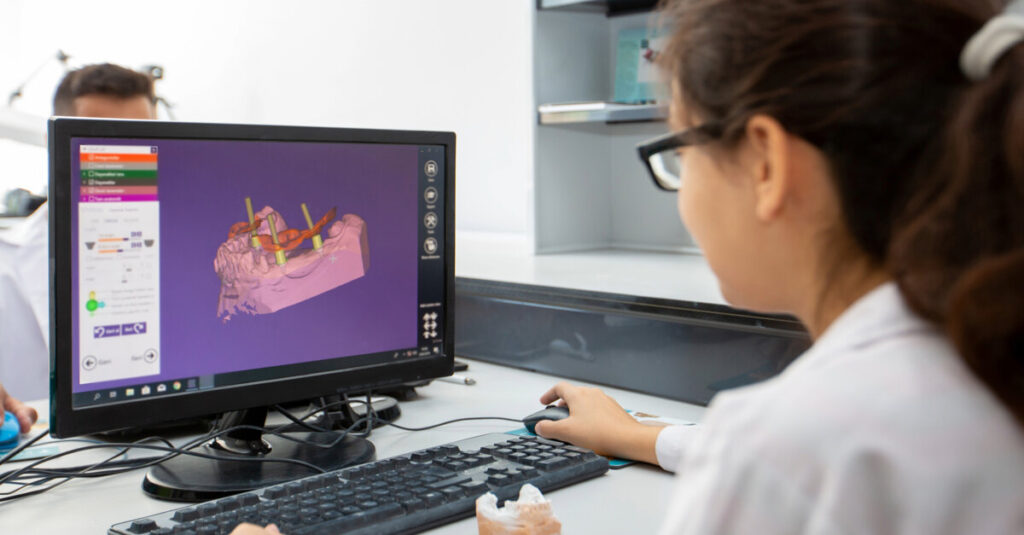
The field of digital implantology continues to develop intensively, shaping a new paradigm of planning and navigation in clinical practice; in this context, a key factor of progress becomes not only technological accuracy, but also the predictability of clinical decisions that contributes to the standardization of treatment.
Research, published online on June 3, 2026 in Clinical Oral Implants Research, evaluated the clinical applicability of AI‑supported implant planning in the maxillary esthetic zone on 35 retrospectively selected single-tooth cases and presented a comparative analysis with virtual planning performed by an experienced prosthodontist; below is an analytical interpretation of the results with an emphasis on accuracy, reproducibility and time efficiency for clinical practice.
Artificial intelligence as a key tool
The authors demonstrate that AI‑generated preliminary plans serve not only as an automated calculation of implant positions, but also as a standardized starting point for the clinician — this reduces subjective variability between sessions and serves as the basis for a reproducible workflow. An important clinical observation was the concordance of AI assessments of bone volume around planned implants with criteria significant for primary stability and subsequent tissue regeneration; such results increase confidence in digital provisional models and virtual wax-ups as components of preoperative planning.
Clinical validation: accuracy and reproducibility
The comparative assessment did not reveal statistically significant differences in labial and palatal plate thickness, distances to adjacent teeth and crestal bone, which indicates clinically reproducible accuracy of the AI plans in the tested population; this suggests that AI is capable of functioning as an averaged standard, reducing inter-operator variability. For clinicians, this means the possibility of using AI as a control tool in complex assessments of anatomical landmarks, while the final clinical decision remains with the operator, who must confirm the implant position taking into account biomechanics, prosthetic requirements and soft tissue biology.
Leuven as a strategic venue
Conducting the study in Leuven underscores the importance of multicenter and transnational cooperation in the validation of digital tools — verification of algorithms in different populations and imaging conditions is important for the generalizability of results; integration of local expertise and international standards accelerates the diffusion of methodologies and contributes to the harmonization of planning and surgical guide manufacturing protocols.
Time and efficiency: speed and standardization
The authors note a reduction in planning time of approximately 40 percent when using AI — median 246 seconds versus 420 seconds for manual clinician planning — which demonstrates the potential to accelerate the workflow and increase operational efficiency. On repeated sessions the AI workflow showed high reproducibility without measurable deviations, whereas human planning showed variability; this emphasizes the importance of digital tools for standardizing processes, optimizing laboratory stages and reducing the risk of errors when transferring data for guide manufacturing.
Clinical and regulatory comments
From a practical point of view, the implementation of AI in implant planning requires sequential clinical validation, quality control of segmentation, algorithm transparency and a documented protocol for specialist confirmation of positions; it is also necessary to consider issues of compatibility with CAD/CAM systems, permissible errors when translating a virtual plan into a physical guide and requirements for interfaces between digital workstations, radiological data and laboratories. For everyday practice it is important to implement step-by-step protocols: verification of anatomical landmarks, assessment of bone volume, verification of the implant’s relation to splinted and non-removable support, as well as documentation of decisions for subsequent audit and staff training.
Conclusion
The study Clinical applicability of artificial intelligence–driven implant planning and surgical guide design in the maxillary esthetic zone confirms that modern AI solutions are capable of becoming an integral part of the implantological workflow, improving reproducibility, reducing planning time and contributing to the standardization of clinical protocols; at the same time, responsibility for the final prosthetic and surgical decision remains with the clinician. For safe and effective implementation further prospective studies, validation in different clinical contexts and the development of regulations for quality control of digital workflows are required.
Modern dentistry is undergoing a period of profound transformations in which issues of clinical effectiveness intertwine with the environmental challenges
We use cookies to improve website performance, analyze traffic, and personalize content. You can accept all cookies or customize their use. Learn more in our Cookie Policy.
Functional
Always active
Technical storage or access is strictly necessary for the legitimate purpose of making possible the use of a particular service expressly requested by the subscriber or user, or solely for the purpose of carrying out the transmission of a message over an electronic communications network.
Preferences
The technical storage or access is necessary for the legitimate purpose of storing preferences that are not requested by the subscriber or user.
Statistics
Technical storage or access used solely for statistical purposes.The technical storage or access that is used exclusively for anonymous statistical purposes. Without a subpoena, voluntary compliance on the part of your Internet Service Provider, or additional records from a third party, information stored or retrieved for this purpose alone cannot usually be used to identify you.
Marketing
Technical storage or access is necessary to create user profiles for the purpose of sending advertising or to track a user across a website or multiple websites for similar marketing purposes.