Main » Uncategorized » Soft tissue management in implantology: 8-year stability and transformation of clinical predictability
Soft tissue management in implantology: 8-year stability and transformation of clinical predictability
Contemporary implantology is developing under conditions of high technological and clinical complexity, requiring interdisciplinary integration, standardization and synchronization of standards.
The key clinical task remains ensuring the stability of peri-implant soft tissues, which determines functional predictability, aesthetic outcome and long-term stability of restorations. In an adapted version of the interview Dr. Elias Jean-Jacques Khouri discusses practical approaches to preplanning, intraoperative and postoperative management of soft tissues, relying on clinically validated concepts.
Soft tissues as a key factor
The stability of the peri-implant mucosa requires an optimal volume of keratinized tissue, sufficient thickness of the connective tissue layer and adequate vascularization to support early and late epithelialization; these parameters form the basis for a clinically stable outcome and minimize the risk of recession and inflammatory complications.
Free connective tissue grafts and pedicled palatal flaps are considered not only as donor material but also as instruments for volume augmentation and reduction of postoperative regression; in a number of studies autogenous grafts retain the status of the “gold standard” for predictability and stability of the result.
Additionally, minimally invasive techniques such as the soft-tissue punch during extraction contribute to clot protection, accelerated epithelialization and improvement of the implant emergence profile in the aesthetic zone.
Preplanning: assessment and principles
Preplanning should include clinical assessment of the level of attached and keratinized mucosa, biotype thickness, alveolar ridge anatomy and vascular potential of the recipient site taking into account the need to synchronize the volume of bone augmentation and the possibilities of soft tissue reconstruction.
Key diagnostic elements
It is necessary to document the volume of soft tissues, the position of the gingival margin relative to contact points, the presence of scar tissue and the thickness of the mucosa — this information determines the choice of technique (free graft, pedicled flap, apically positioned flap or the use of xenogeneic matrices) and the timing of invasive interventions.
Preplanning performs the function of forecasting timings that optimize vascular support of grafts; in most protocols free grafts are used as a standard tool to increase volume and enhance predictability in pre-implant reconstruction.
Surgical techniques as an instrument
Intraoperative incision design, flap mobilization and suture strategy determine the possibility of tension-free closure — a key condition for protection of osteoconductive matrices and prevention of graft exposure.
Incision design and flap mobilization
Careful flap planning with preservation of the vascular pedicle, minimization of trauma and provision of an area for tension-free advancement reduces the risk of dehiscence; tunneling and lateral-tunneling techniques move the wound line away from the augmentation area and decrease the likelihood of exposure of the bone graft.
Specifics for the mandible and alternative flaps
In cases of keratinized mucosa deficiency in the mandible the classic Kazanjian vestibuloplasty provides single-stage vestibule restoration and formation of an attached, cleanable mucosa; the massetero-buccal-periosteal flap serves as a regional alternative, providing a double-layer closure in areas with a high risk of exposure.
The choice of technique should be based on the condition of the recipient site, availability of donor material and required vascularization; when using pedicled flaps it is important to maintain a delicate peristaltic contact and minimal mobilization to preserve blood supply.
Postoperative management and long-term stability
Postoperative management is aimed at maintaining reproducible surgical procedures and adherence to care protocols to reduce inflammation, prevent recurrence and ensure the stability of peri-implant tissues in the long term.
Postoperative care tactics
Regimens that provide load control in the early period, maintenance of hygiene without trauma to flaps, adequate antimicrobial and anti-inflammatory therapy as indicated, and scheduling of follow-up visits for early revision in case of signs of dehiscence or graft exposure are recommended.
Free mucosal grafts, apically positioned flaps and combined methods remain clinically validated options for increasing the zone of attached keratinized tissue; roll-flaps are used for horizontal volume augmentation and optimization of the emergence profile in the aesthetic zone, papilla reconstruction is planned individually taking into account the defect and biomorphology of adjacent teeth or implants.
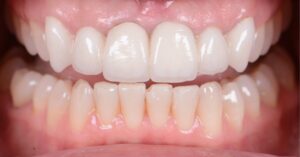
Demonstration of stable peri-implant tissue eight years after prosthetic rehabilitation emphasizes the effectiveness of approaches based on biological consideration of vascularization, tension-free closure and sequential postoperative management.
Perspectives: integration of digital and biological solutions
The future paradigm of implantology will rely on biologically managed concepts combining digital planning, navigation and evidence-based medicine to increase reproducibility and reduce barriers to innovation implementation.
Digital tools accelerate the integration of interdisciplinary protocols — planning of implant position, modeling of soft tissue volume and templates for minimally invasive accesses allow prediction of outcomes and standardization of interventions.
Expert comment: clinicians should maintain a balance between the use of autogenous tissues and new biomaterials — when autografts are not feasible xenogeneic matrices may be an option, however the choice should be based on the evidence base and individual patient parameters such as biotype, aesthetic requirements and risk of complications.
Conclusion
Soft tissue management demonstrates that contemporary implantology is developing as an integrated ecosystem where success is determined by the synergy of surgical technique, preplanning, sequential postoperative care and implementation of digital technologies; clinical cooperation and knowledge exchange remain key to improving the quality of healthcare.
Case report: Bleach‑shade full‑smile rehabilitation using KATANA Zirconia YML and CERABIEN ZR Introduction / Background Authors Kostia Vyshamirski and Dr
We use cookies to improve website performance, analyze traffic, and personalize content. You can accept all cookies or customize their use. Learn more in our Cookie Policy.
Functional
Always active
Technical storage or access is strictly necessary for the legitimate purpose of making possible the use of a particular service expressly requested by the subscriber or user, or solely for the purpose of carrying out the transmission of a message over an electronic communications network.
Preferences
The technical storage or access is necessary for the legitimate purpose of storing preferences that are not requested by the subscriber or user.
Statistics
Technical storage or access used solely for statistical purposes.The technical storage or access that is used exclusively for anonymous statistical purposes. Without a subpoena, voluntary compliance on the part of your Internet Service Provider, or additional records from a third party, information stored or retrieved for this purpose alone cannot usually be used to identify you.
Marketing
Technical storage or access is necessary to create user profiles for the purpose of sending advertising or to track a user across a website or multiple websites for similar marketing purposes.