Main » New in Dentistry » Smart View – Detect: 46% relative increase in sensitivity and transformation of periapical lesion diagnostics
Smart View – Detect: 46% relative increase in sensitivity and transformation of periapical lesion diagnostics
In the era of rapid digitalization, modern dentistry is developing as one of the most dynamic fields of medicine, encompassing digital imaging and AI algorithms.
In this context, a key factor of progress becomes not only the development of algorithms but also the translation of clinically validated tools into everyday practice. Recently, Dentsply Sirona introduced Smart View – Detect — a highly accurate AI tool for the detection of periapical radiolucencies in CBCT scans, which received FDA approval and CE marking.
Brief description of Smart View – Detect
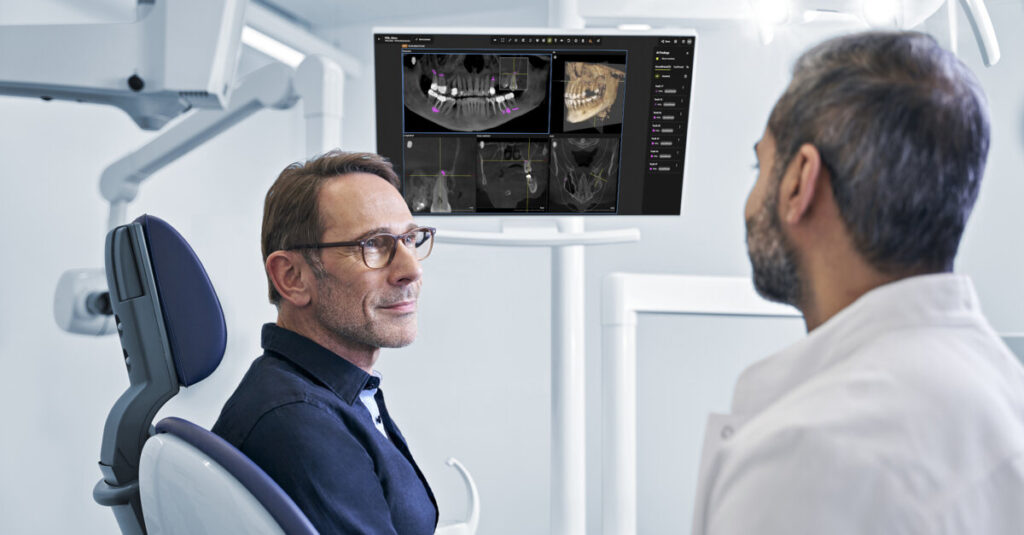
Smart View – Detect is intended for the automatic identification of areas of increased radiolucency within CBCT volumes with visual highlighting of regions of interest on three-dimensional and sectional images, which simplifies the interpretation of high-volume data.
Technology and certification
The tool uses machine learning algorithms trained on annotated sets of CBCT scans and has undergone validation and regulatory review processes that confirmed compliance with safety and efficacy requirements for the US and European markets.
Clinical studies and accuracy metrics
An internal multi-reader clinical study shows approximately a 46% relative increase in sensitivity at the tooth level compared with interpretation without the tool. At the same time, no significant increase in the number of false-positive findings was noted, which is important for maintaining specificity and clinical utility.
Diagnosis as a key factor
Visualization and highlighting of regions of interest in three-dimensional tomograms increase the informativeness of the diagnosis of periapical lesions. The tool acts as an adjunctive means, enhancing reproducibility of lesion detection and facilitating communication with the patient and colleagues.
Integration and compatibility: DS Core
DS Core is considered not merely as a cloud platform for image processing but as a component of a unified digital ecosystem for clinical practice, providing storage, processing and access to data.
Compatibility with equipment and historical data
Smart View – Detect integrates with Dentsply Sirona CBCT systems and supports the import of historical scans from Sidexis 4, allowing the analysis of cumulative data without the need to purchase new equipment.
Distribution model
The feature is available via subscription to DS Core Standard or Advanced, which lowers barriers to adoption and accelerates clinic access to the tool while preserving workflow continuity.
Geography and availability
After receiving regulatory approvals, the product is already available in the USA and Europe, which contributes to the transnational diffusion of technologies and the unification of approaches to digital diagnostics in endodontics and general dentistry.
Clinical significance: interpretation and decision-making
Smart View – Detect does not provide a definitive diagnostic conclusion but serves as an important adjunctive indicator. Visualization of regions of interest helps to justify additional diagnostic measures and therapeutic decisions, as well as to improve informed patient consent.
The algorithm should be viewed as part of a comprehensive assessment that includes:
pulp testing and periodontal assessment (probing depth, presence of pockets);
comparison with two-dimensional radiographs and dynamic follow-up.
Practical recommendations for clinicians
For the adequate use of the AI tool, the following approaches are recommended:
check the algorithm results in multiple orthogonal slices and in volume;
take into account artifacts from restorations and root canals (metal posts, amalgam), which may distort visualization;
correlate identified radiolucencies with clinical data and the dynamics of changes on repeat examinations;
confirm findings with invasive and non-invasive tests as indicated before planning surgical intervention;
perform local verification of the method’s effectiveness on your own patient population to assess the transferability of sensitivity and specificity metrics in your practice.
Limitations and considerations
It is necessary to consider a number of limitations:
the algorithm depends on the quality of the original scan (voxel size, field of view, exposure levels);
false-positive/false-negative findings are possible in the presence of pronounced artifacts or with very early or small lesions;
internal manufacturer studies are important, but independent post-marketing validation in different clinical populations increases confidence in use;
the tool does not replace clinical reasoning and does not eliminate the need for comprehensive diagnostics and differential diagnosis of periapical lesions (granuloma, cystic formations, chronic apical periodontitis, arthritis and other etiologies).
Conclusion
Smart View – Detect represents a pragmatic implementation of AI into dental practice, increasing the sensitivity of detection of periapical radiolucencies and simplifying the interpretation of CBCT scans provided it is properly integrated into the clinical protocol. For the practicing clinician it is important to perceive the tool as an auxiliary module, to perform local validation and to maintain a comprehensive approach to diagnosis and treatment.
Digitalization and additive technologies are radically transforming the dental industry, forming new production and clinical development paradigms. The key challenge
We use cookies to improve website performance, analyze traffic, and personalize content. You can accept all cookies or customize their use. Learn more in our Cookie Policy.
Functional
Always active
Technical storage or access is strictly necessary for the legitimate purpose of making possible the use of a particular service expressly requested by the subscriber or user, or solely for the purpose of carrying out the transmission of a message over an electronic communications network.
Preferences
The technical storage or access is necessary for the legitimate purpose of storing preferences that are not requested by the subscriber or user.
Statistics
Technical storage or access used solely for statistical purposes.The technical storage or access that is used exclusively for anonymous statistical purposes. Without a subpoena, voluntary compliance on the part of your Internet Service Provider, or additional records from a third party, information stored or retrieved for this purpose alone cannot usually be used to identify you.
Marketing
Technical storage or access is necessary to create user profiles for the purpose of sending advertising or to track a user across a website or multiple websites for similar marketing purposes.