Main » Technologies » Hybrid composite restorations in a fully digital workflow
Hybrid composite restorations in a fully digital workflow
Modern dentistry is undergoing a profound technological transformation: methods of digital planning, virtual modeling, and additive manufacturing (3D printing) are increasingly being integrated into the clinical process, changing the traditional approach to manufacturing dental restorations. Instead of manual impression taking and making plaster models, the digital workflow allows for obtaining accurate three-dimensional images of the patient’s anatomy, designing an individual restoration, and reproducing it using a 3D printer — quickly, consistently, and with high precision. These technologies not only optimize operational processes in the clinic but also improve the quality of final treatment results.
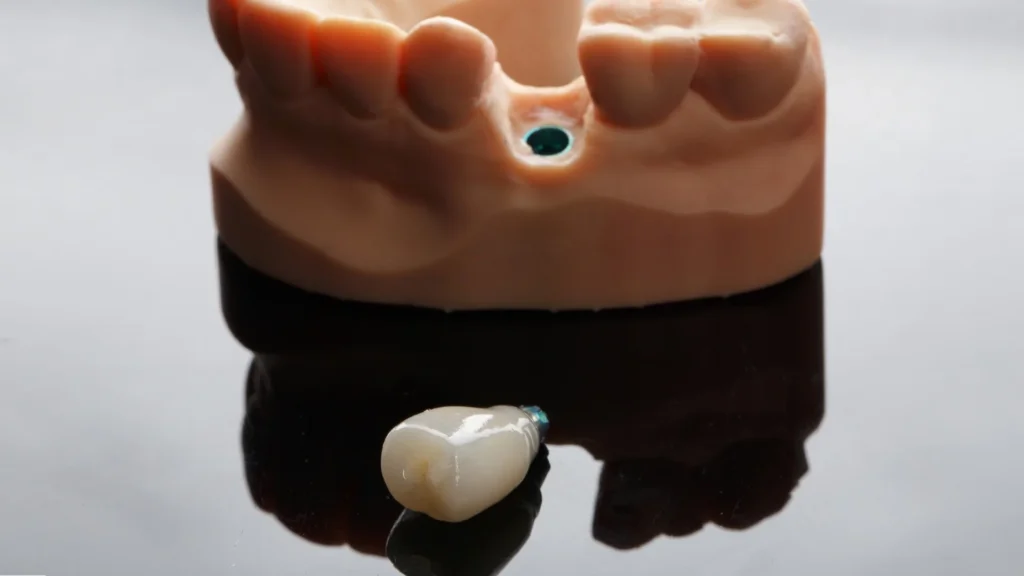
One of the recent practical applications of this approach was a case involving the use of a 3D-printed hybrid composite restoration, fabricated within a fully digital protocol — from scanning to final placement.
The essence and technological components of the digital protocol
At the core of the digital workflow is computer-aided design and additive manufacturing (CAD/CAM), which combines digital scanning, virtual design, and 3D printing of restorations without the need for traditional impressions and laboratory stages. Intraoral scanners create three-dimensional models of teeth and occlusal surfaces, which can be directly imported into CAD software for restoration design. The generated models are then sent to a 3D printer, which reproduces the restoration material with a high degree of accuracy.
Hybrid composite materials used in such restorations represent an aggregate of glass-filled or polymer-infiltrated composites, providing the combination of strength and aesthetics necessary for long-term restorations. Such materials allow for the additive manufacturing of complex shapes with optimized mechanical properties.
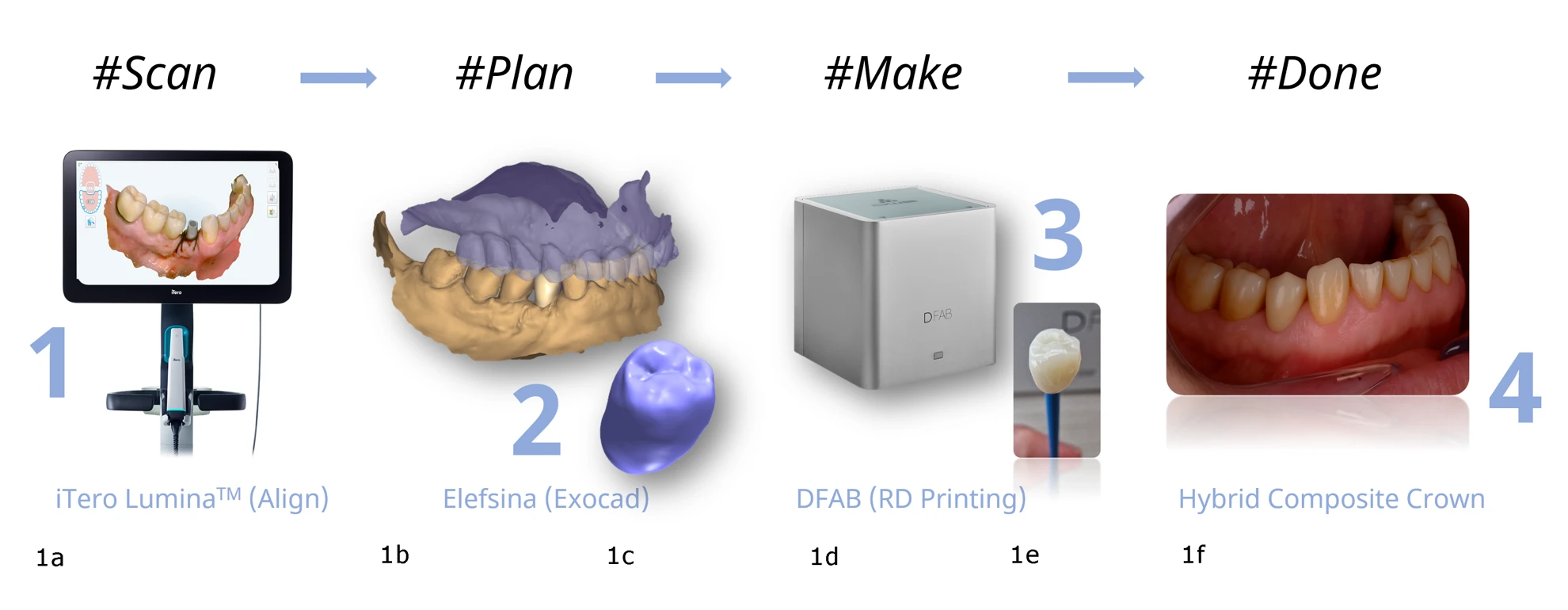
Fig. 3. 1a–f: Overview of the digital workflow for manufacturing a hybrid composite restoration using 3D printing. Intraoral scanning with iTero Lumina (Align Technology; a). CAD modeling with DentalCAD (exocad), resulting in the creation of an STL file of the final restoration design (b and c). High-precision 3D printing of the restoration with Dfab using Irix Max (d and e), followed by post-polymerization, polishing, and delivery of the restoration to the patient (f).
Clinical observations and application experience
A recent clinical report included in the discussion describes the application of a 3D-printed hybrid composite restoration in the restoration of a posterior tooth with an extensive carious lesion and complicated endodontic treatment. Within the fully digital process, the clinician first performed an intraoral scan of the affected area using a high-precision scanner, then designed the restoration in a CAD environment, and fabricated it using a 3D printer. The finished restoration was adhesively cemented in the patient’s oral cavity under isolation, ensuring a high precision fit and stability.
Such cases confirm that additive methods can be successfully implemented in clinical practice, especially when it comes to partial restorations (e.g., onlays) requiring precise adaptation to the unique anatomy of the tooth. Moreover, publications with patient follow-up over six months and a year note favorable results: stability of fixation, satisfactory aesthetic perception, and the absence of complications, which indicates the high potential of digital hybrid composites as an alternative to traditional methods.
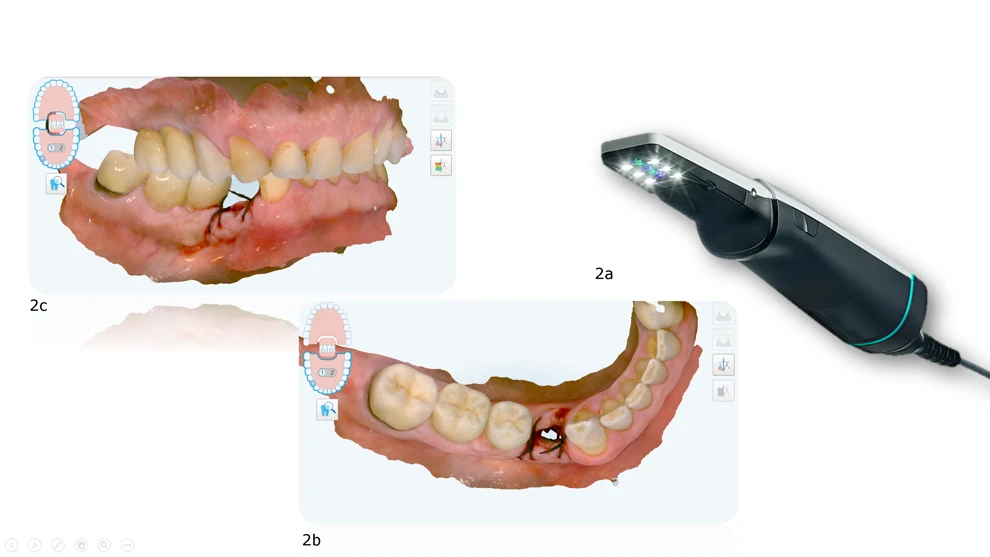
Fig. 3. 2a–c: Intraoral scanning with the iTero Lumina scanner (a) begins with the opposing quadrant (b), and then the reference model (c) after removal of the healing abutment, followed by occlusal registration. In this case, scanning was performed immediately after implant placement, while the sutures were still in place. Fig. 3. 3a–c: Intraoral scanning with the iTero Lumina scanner (a) was performed, capturing the spatial position of the implant on the reference model after the implant body was screwed in: occlusal (b) and buccal (c) view.
Advantages and impact on clinical practice
By transitioning to a digital workflow using 3D printing, dentists gain several significant advantages. The technology allows for reducing the number of patient visits, decreasing the production time of restorations, and increasing the precision of their fit, since digital data eliminates inaccuracies associated with physical impressions and the laboratory stage. Furthermore, hybrid composite materials demonstrate good adaptation, the possibility of adjustment, and predictable integration with dental tissues, making them a promising option for partial prosthetics.
The fully digital protocol also facilitates improved communication between the dentist and the dental technician (if an external lab is involved), as the entire process is based on virtual models that are easily transferable and modifiable. This increases clinical confidence and allows for faster adaptation of the treatment plan to the individual characteristics of the patient.
Conclusion: digitalization as a stage in the evolution of restorative dentistry
3D printing of hybrid composite restorations within a fully digital workflow illustrates the shift from traditional techniques to integrated digital solutions that enhance the accuracy, efficiency, and predictability of treatment. These methods allow modern dentistry to offer patients more personalized and convenient options for restorative care, reducing overall treatment time and improving the quality of outcomes. Based on clinical observations and current research, it can be stated that the digital protocol of additive manufacturing represents a significant step forward on the path to more accurate and efficient models of restorative practice.
Modern dentistry is undergoing a rapid digital transformation, integrating CAD/CAM technologies into clinical and laboratory workflows, increasing efficiency. CAD/CAM and
Modern restorative dentistry is undergoing an intensive transformation associated with the diffusion of digital technologies and new composite materials. The
We use cookies to improve website performance, analyze traffic, and personalize content. You can accept all cookies or customize their use. Learn more in our Cookie Policy.
Functional
Always active
Technical storage or access is strictly necessary for the legitimate purpose of making possible the use of a particular service expressly requested by the subscriber or user, or solely for the purpose of carrying out the transmission of a message over an electronic communications network.
Preferences
The technical storage or access is necessary for the legitimate purpose of storing preferences that are not requested by the subscriber or user.
Statistics
Technical storage or access used solely for statistical purposes.The technical storage or access that is used exclusively for anonymous statistical purposes. Without a subpoena, voluntary compliance on the part of your Internet Service Provider, or additional records from a third party, information stored or retrieved for this purpose alone cannot usually be used to identify you.
Marketing
Technical storage or access is necessary to create user profiles for the purpose of sending advertising or to track a user across a website or multiple websites for similar marketing purposes.