Main » New in Dentistry » Time as a Key Factor in the Success of Implant Treatment: The Opening of the Joint EAO–SFPIO Congress in Monaco
Time as a Key Factor in the Success of Implant Treatment: The Opening of the Joint EAO–SFPIO Congress in Monaco
International scientific congresses in dentistry play a crucial role in shaping clinical standards, exchanging best practices, and defining future directions for the specialty. This is especially relevant for implantology — one of the most dynamically evolving areas of modern dentistry, where clinical decisions are increasingly based on precise scientific data, interdisciplinary collaboration, and technological innovation. In this context, the opening of the 32nd Annual Scientific Congress of the European Association for Osseointegration (EAO), held in Monaco in cooperation with the French Society of Periodontology and Oral Implantology (SFPIO), has become a significant event for the global professional community.
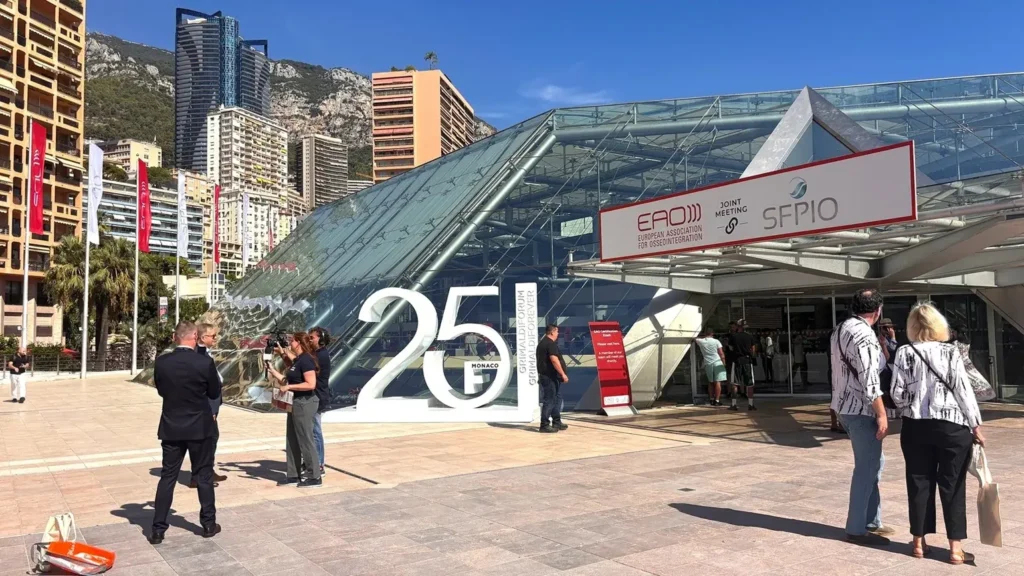
On September 18, 2025, the 32nd Annual Scientific Congress of the EAO officially commenced its work at the Grimaldi Forum in Monaco. The association returned to the Côte d’Azur for the first time since 2009, gathering thousands of clinicians, researchers, and educators from around the world over three days. The congress is rightly considered one of the most authoritative and large-scale events in the field of implantology, which is confirmed by statistics from previous years: in 2024 in Milan, it was attended by over 4,700 delegates.
The joint organization of the event with SFPIO underscores the shared commitment of both professional associations to the principles of evidence-based medicine and an interdisciplinary approach. This cooperation reflects the contemporary understanding of implant treatment as a comprehensive process that requires consideration of surgical, prosthetic, periodontal, and biological factors.
The central theme of the 2025 congress was the concept of “The Influence of Time in Implantology.” Within this theme, the critical role of temporal parameters at all stages of treatment is discussed — from planning and implant placement to prosthetics and long-term follow-up. Participants are invited to consider how the choice of timing for surgical intervention, immediate or delayed loading, as well as the timing of regenerative procedures, influences osseointegration, implant stability, and clinical prognosis.
The scientific program includes interactive presentations by leading international experts, live video broadcasts of clinical procedures, and panel discussions focused on the practical application of scientific data. One of the key events of the congress was the presentation of the first Global Consensus on Clinical Guidelines in Implantology — a document aimed at establishing new benchmarks and standardizing treatment approaches internationally. It is anticipated that this consensus will have a long-term impact on clinical practice and educational programs in many countries.
Technology, Accessibility, and Industry Participation
A significant innovation of the congress was the use of artificial intelligence to translate sessions of the main scientific program into more than 60 languages. With the congress’s official working language being English, this decision significantly expands the accessibility of scientific content and facilitates more active engagement of specialists from different regions of the world.
In addition to the scientific program, the congress includes a large-scale exhibition where leading companies present the latest technologies and solutions in implantology. Practice-oriented hands-on sessions organized by industry partners, including BioHorizons Camlog, ClaroNav, SHINING 3D, and Zircon Medical, complement the educational component of the event and allow participants to directly familiarize themselves with modern digital and surgical tools.
Conclusion
The joint EAO–SFPIO Congress 2025 in Monaco vividly demonstrates the maturity and scientific depth of modern implantology. The focus on the time factor as a key element of successful treatment reflects the professional community’s aspiration for more precise, personalized, and predictable clinical solutions. The presentation of a global clinical consensus, the active adoption of digital technologies, and the expansion of international dialogue underscore the strategic role of such events in shaping the future of the specialty.
Thus, the congress in Monaco serves not only as a platform for knowledge exchange but also as a tool for consolidating the global implantology community, setting the direction for the development of clinical practice, science, and education in the field of dental implantology for the coming years.
We use cookies to improve website performance, analyze traffic, and personalize content. You can accept all cookies or customize their use. Learn more in our Cookie Policy.
Functional
Always active
Technical storage or access is strictly necessary for the legitimate purpose of making possible the use of a particular service expressly requested by the subscriber or user, or solely for the purpose of carrying out the transmission of a message over an electronic communications network.
Preferences
The technical storage or access is necessary for the legitimate purpose of storing preferences that are not requested by the subscriber or user.
Statistics
Technical storage or access used solely for statistical purposes.The technical storage or access that is used exclusively for anonymous statistical purposes. Without a subpoena, voluntary compliance on the part of your Internet Service Provider, or additional records from a third party, information stored or retrieved for this purpose alone cannot usually be used to identify you.
Marketing
Technical storage or access is necessary to create user profiles for the purpose of sending advertising or to track a user across a website or multiple websites for similar marketing purposes.