Main » Uncategorized » Combined Computer-Aided Orthopedic Surgery in Jaw Rehabilitation: Synergy of Navigation, Robotics, and Photogrammetry in the Quad Zygoma Protocol
Combined Computer-Aided Orthopedic Surgery in Jaw Rehabilitation: Synergy of Navigation, Robotics, and Photogrammetry in the Quad Zygoma Protocol
“`html
Modern implantology increasingly turns to the synergy of various navigation technologies, selecting the most effective method for each clinical scenario. The presented case demonstrates a comprehensive approach: dynamic navigation for zygomatic implant placement in the maxilla, robot-assisted implant positioning in the mandible, and photogrammetry for immediate prosthodontics.
Computer-assisted implant surgery (CAIS) has ceased to be a single technology and has transformed into a comprehensive workflow centered on digital treatment planning. It includes three distinct modalities of execution: static surgical guides, dynamic navigation, and autonomous robotic systems — each with its own accuracy profile, specialist preparation requirements, and anatomical appropriateness. International consensus confirms that all guided techniques improve implant placement accuracy compared to manual technique; however, clinically meaningful advantage is achieved by aligning the method with the specific complexity of the surgical task and patient needs, rather than universal application of a single technique.
Clinical scenario
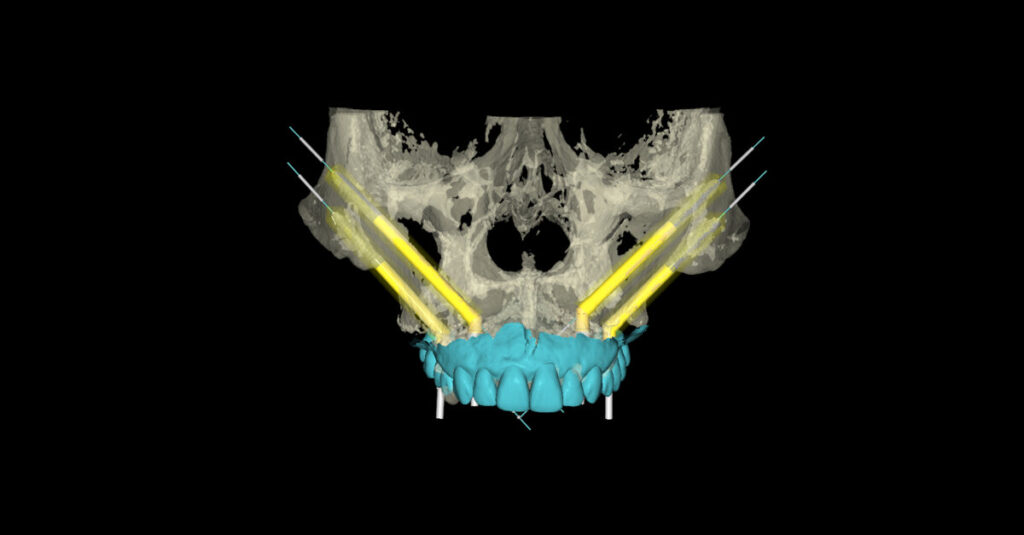
A 59-year-old patient presented for treatment with terminal edentulism of both jaws, complicated by bilateral pneumatization of the maxillary sinuses. The condition precluded the use of short or tilted implants and required the application of the quad zygoma protocol (four zygomatic implants) in the maxilla. The anatomy of both arches permitted a staged approach: long angulated trajectories of zygomatic implants near the orbit and skull base required full navigational support with surgeon control, whereas standardized mandibular osteotomies were a good candidate for autonomous robot-assisted preparation.
Surgical protocol
Four zygomatic NobelZygoma 45° implants were placed in the maxilla under dynamic navigation (X-Guide). Immediate fixation of multi-unit abutments allowed the use of intraoral photogrammetry (FastMap) for direct capture of the spatial position of all four elements without traditional impression — critically important for accurate fabrication of the provisional prosthesis.
At 11 days, mandibular surgery was performed using the Yakebot robot. The system autonomously performed osteotomy and placement of four classical Straumann BLX implants under continuous surgeon control. Photogrammetry was also applied here — for implant registration at the abutment level.
Provisional prostheses were delivered on the fourth postoperative day following maxillary surgery and on the third day following mandibular surgery. Definitive prostheses (metal-ceramic, screw-retained) were fabricated at 6.5 months.
Complications and clinical outcome
The postoperative course was complicated by two episodes of maxillary sinusitis. The first manifested at eight weeks with an oro-antral communication in the region of implant #26, managed conservatively without implant removal. The second, less pronounced, resolved following oral antibiotic therapy prior to delivery of the definitive prostheses.
At 16-month follow-up examination, all eight implants remained stable. Both prostheses functioned without complications; only local calculus deposits and minor screw access damage were noted — both requiring routine maintenance. Sinusitis and soft tissue complications did not recur.
Integration of photogrammetry in the digital workflow
Photogrammetry in this case fulfilled a role that is often underestimated: registration of four highly divergent zygomatic implant trajectories by traditional impression is technically challenging and prone to distortion. Integration of photogrammetry into the navigation process accelerated the workflow, reduced treatment time, and eliminated the need for additional devices. Direct capture of the spatial position of elements in the oral cavity provided the high accuracy necessary for immediate prosthodontics on complexly oriented implants.
Sinusitis in quad zygoma protocol: clinical significance
The clinically evident sinusitis is consistent with the known complication profile of the quad zygoma protocol in long-term series, where sinus inflammation and local oro-facial reaction are among frequently occurring events. Invasion of foreign bodies into the maxillary sinus, particularly with pneumatized sinuses and the necessity for zygomatic implants, carries the risk of microbial contamination. Conservative management without implant removal proved effective in this case; however, long-term monitoring remains mandatory for patients following quad zygoma reconstructions.
Limitations and perspectives
The study is limited by retrospective analysis of a single clinical case; prospective comparative data remain necessary to establish the relative advantages of a combined approach with multiple CAIS modalities in a single treatment program. However, practical experience demonstrates that the synergy of dynamic navigation, robot-assisted milling, and photogrammetry allows optimization of outcomes in full rehabilitation for the most complex anatomical cases.
We use cookies to improve website performance, analyze traffic, and personalize content. You can accept all cookies or customize their use. Learn more in our Cookie Policy.
Functional
Always active
Technical storage or access is strictly necessary for the legitimate purpose of making possible the use of a particular service expressly requested by the subscriber or user, or solely for the purpose of carrying out the transmission of a message over an electronic communications network.
Preferences
The technical storage or access is necessary for the legitimate purpose of storing preferences that are not requested by the subscriber or user.
Statistics
Technical storage or access used solely for statistical purposes.The technical storage or access that is used exclusively for anonymous statistical purposes. Without a subpoena, voluntary compliance on the part of your Internet Service Provider, or additional records from a third party, information stored or retrieved for this purpose alone cannot usually be used to identify you.
Marketing
Technical storage or access is necessary to create user profiles for the purpose of sending advertising or to track a user across a website or multiple websites for similar marketing purposes.