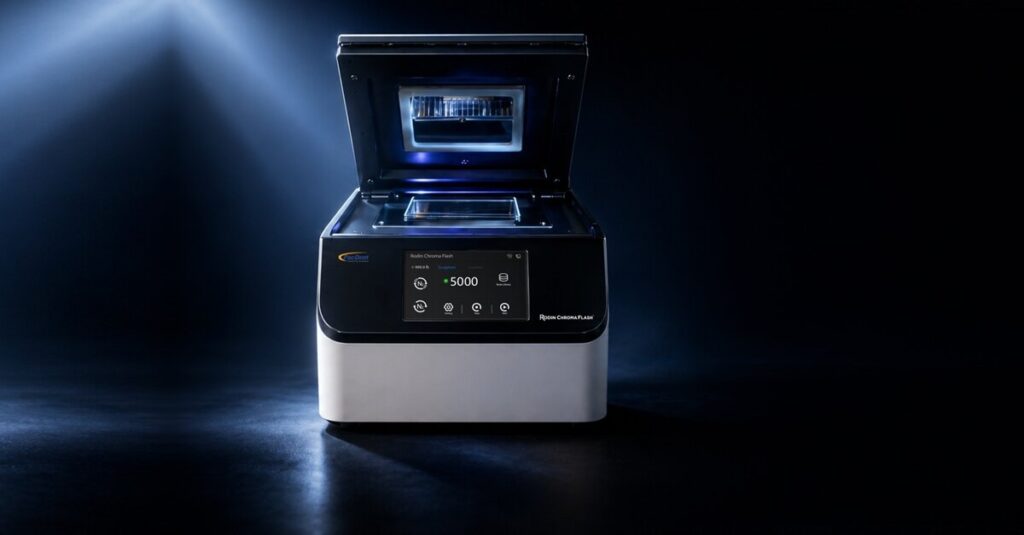

Managing polymerization speed in three-dimensional printing remains one of the key variables affecting the mechanical properties and durability of manufactured structures. Pac-Dent, a developer of materials and solutions for digital dentistry, has expanded the Rodin ecosystem by launching an innovative post-polymerization system Rodin Chroma Flash.
Solving the critical problem of post-polymerization variability
The new system addresses the critical problem of post-polymerization variability — a stage directly affecting the predictability of results in digital dental processes. Rodin Chroma Flash provides controlled high-energy polymerization through flash polymerisation technology, delivering a uniform energy flow in each cycle.
Unlike systems relying on static light exposure and variable chamber conditions, the system introduces a precision approach that minimizes operator-dependent variability and ensures standardized results regardless of production volume.
Key characteristics and advantages
The system is distinguished by unified energy delivery across the entire surface to eliminate under- or over-polymerization; high-intensity flash polymerization that reduces cycle time and increases productivity; improved flexural strength, wear resistance and surface quality indicators. An important advantage lies in the reduction of oxygen inhibition, maintaining the aesthetic result, as well as optimization for ceramic-filled nano-hybrid Rodin resins with compatibility for a wide range of dental materials.
About Pac-Dent
Pac-Dent, founded in 1992, offers a portfolio of solutions in prevention, three-dimensional printing, restorative dentistry, whitening, endodontics and infection control, drawing on more than 30 years of experience in innovation in the dental industry.