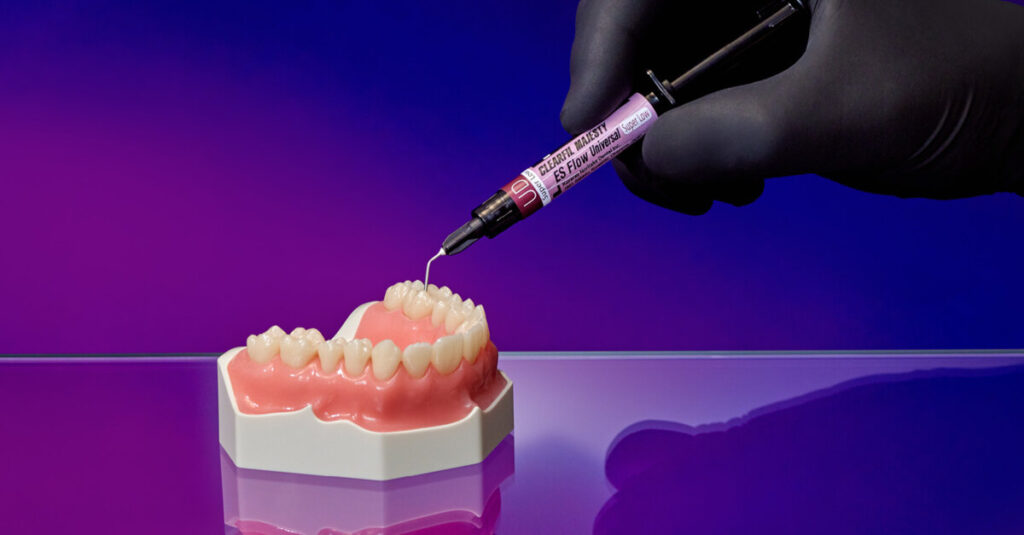
Main » New in Dentistry » CLEARFIL MAJESTY ES Flow Universal: two DENTAL ADVISOR awards and formation of a paradigm of restorative predictability
CLEARFIL MAJESTY ES Flow Universal: two DENTAL ADVISOR awards and formation of a paradigm of restorative predictability
In an era of rapid digitalization and steadily increasing demands for the aesthetics and durability of restorations, contemporary dentistry is developing as one of the most dynamic fields of medicine, requiring a systemic approach to materials and treatment protocols, and in this context a key factor of progress becomes not only the development of new composites but also their clinical and scientific translation.
The article discusses the positioning of CLEARFIL MAJESTY ES Flow Universal as an example of a material combining shade adaptation, ease of handling and mechanical strength; clinical and laboratory indicators, aspects of the shade system and the importance of independent validation for decision-making in the dentist’s practice are discussed.
Material as a key factor
CLEARFIL MAJESTY ES Flow Universal is presented not simply as a flowable composite but as a component of a restorative strategy aimed at integrating clinical and laboratory processes; in practical terms this means the use of the material for adaptive layers, small Class I and III restorations, restorations in the aesthetic zone and correction of marginal adaptation in combined restorations. Important properties include controlled viscosity (Super Low and Low variants), predictable polishability and surface stability — parameters that influence long-term gloss retention and the minimization of plaque accumulation under clinical exposure.
Practical significance is manifested in the reduction of technical difficulties in modeling and adaptation, which positively affects the reproducibility of results between the operatory and the laboratory; the design of the syringe and tip, reduced to the minimization of air inclusions, additionally optimizes material delivery and reduces the likelihood of void formation, which is confirmed by radiographic and microscopic validation.
Shade system: concept and rationale
Simplified universal shade system with the U shade, calculated to cover the VITA classical A1–D4 range, is aimed at simplifying color communication between the clinician and the technician and reducing errors in shade selection under time-constrained appointments; for cases with dark dentin or limited volume of surrounding tissue the UD shade is provided, increasing the flexibility of indications. The decision is based on optical characteristics — translucency and the ability to diffuse light — which are critical for the integration of a flowable composite into multilayered aesthetic restorations.
Clinical commentary: when planning restorations it is important to consider the thickness of the flowable composite layer, interaction with the underlying dentin tissue and the final surface of the polymerizing coating; for pronounced aesthetic requirements a test placement of the color and interaction with the shade of the restorative composite of the top layer is recommended.
Scientific validation: studies and awards
Independent studies at the Biomaterials Research Center DENTAL ADVISOR showed high performance of the Super Low variant in flexural strength, fracture resistance and compressive strength among the group of hybrid flow materials, indicating good mechanical reliability when used under conditions of limited-volume occlusal loading. In addition, reports on the ability to blend shades and radiographically confirmed minimal void formation when injected from a syringe became decisive factors in awarding the material the Research Award and Top Product Award DENTAL ADVISOR.
Expert assessment: receiving independent awards and publishing verification protocols serve as an important element of innovation evaluation, however clinicians should correlate laboratory indicators with real clinical outcomes — restoration lifespan, marginal integrity durability, polishing behavior and response during long-term intraoral service.
Tokyo as a strategic platform
Geopolitical and regulatory context of the development in Tokyo emphasizes the transnational nature of research and the manufacturer’s cooperation with international research centers; the availability of the Super Low variant in the USA and two viscosities in Europe illustrates the adaptation of the product to regional clinical and regulatory requirements. For the practicing clinician this means the necessity to rely on local recommendations for use and training, as well as to take into account differences in supply and technical support.
Clinical recommendations and conclusion
Recommendations for use include using the material as an adhesive adaptive layer in small-volume composite restorations, as a means to seal margins and reduce voids during injection, and for anatomical correction prior to the final placement of a high-strength composite; mandatory measures are correct isolation of the operative field, selection of a compatible adhesive system, adequate polymerization and control of layer thickness. When planning a restoration one should consider shade characteristics, optical properties and mechanical indicators in the context of expected functional loads.
Conclusion: CLEARFIL MAJESTY ES Flow Universal demonstrates a consistent strategy integrating shade simplification, syringe technological design and verified laboratory strength; for clinicians a critical appraisal of both independent validation and their own clinical observations is important in order to optimize protocols and increase the predictability of restorations.
Global trends in dentistry require coordinated efforts to integrate clinical education and business competencies, forming a new professional paradigm. In
We use cookies to improve website performance, analyze traffic, and personalize content. You can accept all cookies or customize their use. Learn more in our Cookie Policy.
Functional
Always active
Technical storage or access is strictly necessary for the legitimate purpose of making possible the use of a particular service expressly requested by the subscriber or user, or solely for the purpose of carrying out the transmission of a message over an electronic communications network.
Preferences
The technical storage or access is necessary for the legitimate purpose of storing preferences that are not requested by the subscriber or user.
Statistics
Technical storage or access used solely for statistical purposes.The technical storage or access that is used exclusively for anonymous statistical purposes. Without a subpoena, voluntary compliance on the part of your Internet Service Provider, or additional records from a third party, information stored or retrieved for this purpose alone cannot usually be used to identify you.
Marketing
Technical storage or access is necessary to create user profiles for the purpose of sending advertising or to track a user across a website or multiple websites for similar marketing purposes.