Main » New in Dentistry » IPS E.max Zirconia: 2 million validation cycles and transformation of digital workflows in restoration
IPS E.max Zirconia: 2 million validation cycles and transformation of digital workflows in restoration
In an era of rapid digitalization contemporary dentistry is developing as one of the most dynamic fields, integrating digital workflows and materials for clinical practice.
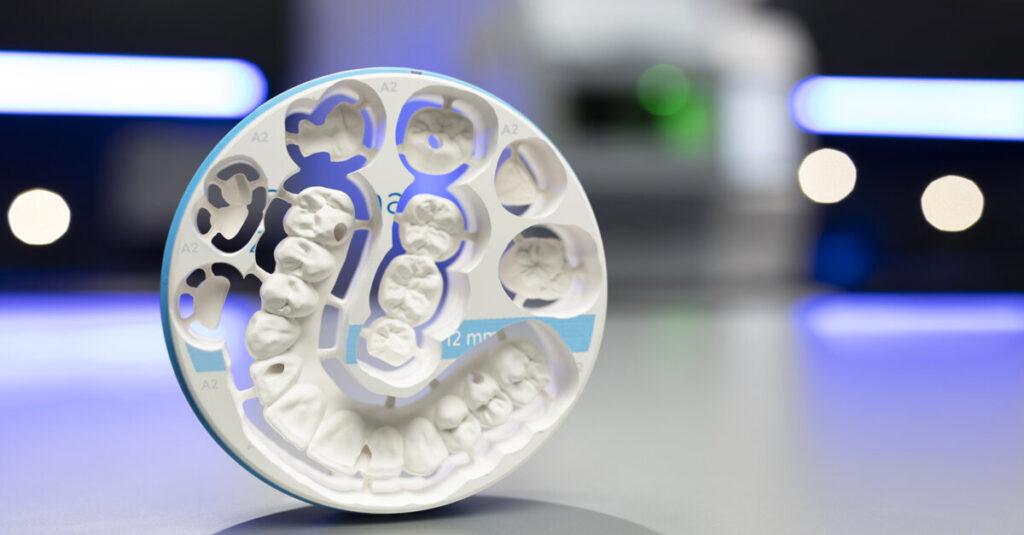
IPS e.max Zirconia from Ivoclar is presented as a new ceramic system developed in collaboration with dental laboratories and aimed at shade reproducibility and increased laboratory productivity; the system is based on a combination of technologies, including GTx Technology and a gradient profile, providing realistic light dynamics and predictable aesthetic integration.
Material as a key factor
The combination of two powders — 4Y‑PSZ and 5Y‑PSZ — forms an optimized microstructure that provides a balance between strength and translucency, which is critical for restorations with high aesthetic demand and for replaceable prosthetic solutions in occlusal load-bearing areas.
Mechanics, aesthetics and shade reproducibility
Thanks to the gradient profile and control of the crystalline phase a more predictable shade match is achieved from chairside scanning to the final restoration, which reduces the need for additional adjustments and shortens clinical time; at the same time the material preserves reproducible and high-precision geometry after milling and sintering, which increases compatibility with digital CAD/CAM processes.
Practical significance for laboratories
From the dental technician’s perspective, IPS e.max Zirconia acts not only as an aesthetic solution but also as a production optimization tool — a stable microstructure and a predictable behavioral profile during heat treatment reduce the percentage of rejects and increase the profitability of laboratory workflows.
Digital workflows: structure and advantage
The system integrates into the digital workflow from intraoral scanning to the finished restoration, reducing logistical and storage needs and providing shorter turnaround times.
Sintering and production cycle speed
The key laboratory effect is achieved through sintering regimes: up to 58 minutes for structures of up to three units and up to 2 hours 57 minutes for full-arch works — this provides strategic time optimization and allows laboratories to reallocate resources to increase volume and quality of work.
Compatibility and customization
Compatibility with the IPS e.max Ceram Art system expands aesthetic possibilities through layered ceramic veneering and signature effects, which is important when fabricating restorations in high-aesthetic zones; the combination of digital predictability and manually performed customization gives flexibility in choosing a clinical strategy.
SCHAAN as a strategic platform
Development in SCHAAN (Liechtenstein) was carried out under conditions of transnational cooperation with the participation of about 40 dental technicians, which reflects the project’s practical orientation and emphasis on real laboratory scenarios.
Validation and clinical reliability
The material underwent intensive testing, including cyclic mechanical tests — two million cycles of masticatory loading at 550 N — demonstrating reproducible mechanical stability; such data are important for assessing the longevity of restorations under functional load and for planning long-term clinical prognoses.
The role of digital processes in standardization
Digital integration acts as a tool for synchronizing standards between the clinic and the laboratory, reducing result variability and simplifying the adoption of innovations into mass practice through standardized protocols and data exchange.
Conclusion
IPS e.max Zirconia demonstrates an approach to restorative practice as an integrated ecosystem where materials, digital workflows and interdisciplinary cooperation form a reproducible paradigm of clinical and laboratory work; for clinicians and dental technicians this means increased predictability of outcomes, reduced treatment time and expanded possibilities for customization.
The relevance of implementing such systems is dictated by the need for accelerated introduction of innovations while maintaining standards of evidence-based medicine, therefore participation in international symposia and the use of digital platforms remain key for experience exchange, standards development and continuous professional development.
We use cookies to improve website performance, analyze traffic, and personalize content. You can accept all cookies or customize their use. Learn more in our Cookie Policy.
Functional
Always active
Technical storage or access is strictly necessary for the legitimate purpose of making possible the use of a particular service expressly requested by the subscriber or user, or solely for the purpose of carrying out the transmission of a message over an electronic communications network.
Preferences
The technical storage or access is necessary for the legitimate purpose of storing preferences that are not requested by the subscriber or user.
Statistics
Technical storage or access used solely for statistical purposes.The technical storage or access that is used exclusively for anonymous statistical purposes. Without a subpoena, voluntary compliance on the part of your Internet Service Provider, or additional records from a third party, information stored or retrieved for this purpose alone cannot usually be used to identify you.
Marketing
Technical storage or access is necessary to create user profiles for the purpose of sending advertising or to track a user across a website or multiple websites for similar marketing purposes.