Main » Scientific articles » Haptic VR in dental education: 14% implementation and transformation of clinical training
Haptic VR in dental education: 14% implementation and transformation of clinical training
In an era of rapid digitalization, contemporary dentistry is developing as one of the most dynamic fields of medicine, actively integrating digital solutions into educational and clinical practices.
In these circumstances the key factor of progress becomes not only the development of technologies, but also their effective translation into curricula and clinical training; this requires a systemic approach to validation, standardization and the development of teaching competencies to ensure the clinical relevance of the implemented tools.
Technology as a key instrument
The results of a survey of 130 educators from 115 institutions in 57 countries provide a quantitative basis for assessing the current state of adoption of immersive tools and the barriers to their dissemination.
According to the study, phantoms and practical exercises occupy about 81% of clinical training time, whereas haptic virtual reality and mixed reality constitute about 14% — such a ratio underscores the existing heterogeneity in approaches to simulation-based education and the need for the diffusion of innovations in educational trajectories.
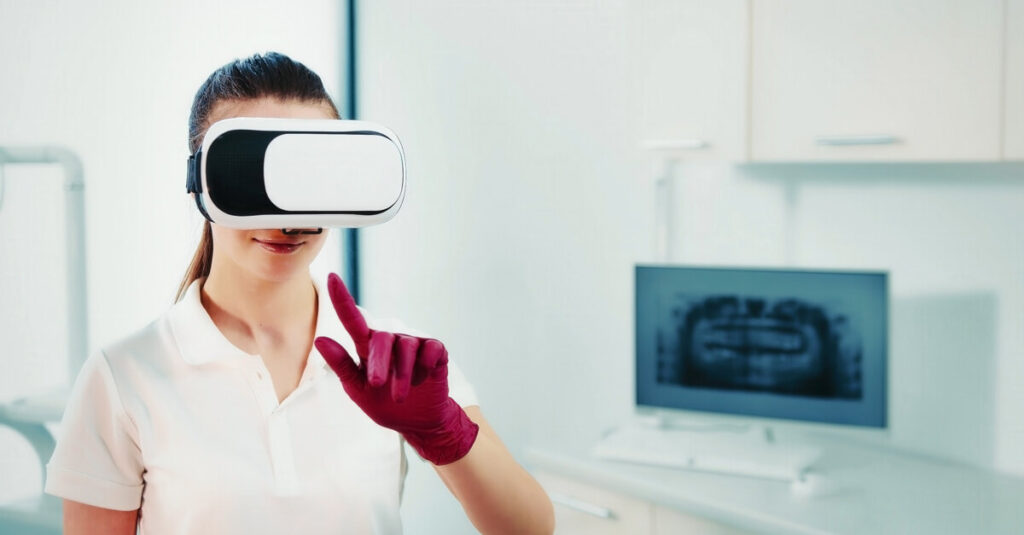
Haptic VR should be regarded not as a decorative element, but as a means for high-precision simulation of tactile responses and the kinesthetics of procedures, allowing one to increase the reproducibility and objectivity of skills assessment, reduce the variability of training cases and facilitate the analysis of errors at the level of execution technique.
Educational ecosystem: structure and content
The integration of immersive tools is more widespread in undergraduate programs, where national accreditation requirements, large teaching teams and long-term planning create prerequisites for adoption; in contrast, postgraduate programs, developed by small groups and oriented toward narrow competencies, have fewer resources for scaling technologies and more often face the barrier of time for staff training.
Systemic integration of haptic VR performs not only the function of a skills trainer, but also a platform for the standardization of assessment and the synchronization of clinical standards, relying on the principles of evidence-based medicine — this requires the development of comparable efficacy metrics, multicenter studies and the inclusion of immersive modules in competency frameworks.
For sustainable integration the following are necessary: dedicated time for teacher training, institutional continuing professional development programs, the development of educational scenarios with clinical validation and the inclusion of immersive cases in competency assessment plans — all of this should be accompanied by analysis of clinical translation, educational effectiveness and economic feasibility.
Geography as a strategic platform
The socio-economic status of countries directly correlates with the prevalence of the use of immersive technologies, which leads to unequal access to advanced educational tools and to the widening of the digital divide in the training of specialists.
Low- and middle-income countries face problems of power supply reliability, a deficit of trained technical personnel and limited service support — these factors reduce the resilience of implementation and require adaptive solutions, such as lightweight versions of software, offline repositories of cases and local training of technicians.
International cooperation is considered a key mechanism for lowering barriers — collective procurement, shared repositories of digital clinical scenarios, training of “trainer-from-staff” and multicenter validation studies will help accelerate diffusion and create standards suitable for different economic and technical contexts.
Practical recommendations for educators and program leaders
The implementation of scalable programs requires a combination of pilot projects with controlled evaluations, institutional support, allocation of resources for maintenance and servicing of equipment and the development of a human resources strategy for the training of educators and technicians.
I recommend: implementing haptic modules through phased pilots with predetermined baseline metrics, forming interfaculty simulation centers to centralize resources, integrating immersive cases into competency assessment criteria, and initiating multicenter studies to verify the clinical significance of the trained skills — this will reduce uncertainty about effectiveness and justify investments.
Important technical aspects include the assessment of haptic accuracy and feedback frequency, ensuring regular maintenance, API openness for integration with learning management systems and planning the lifecycle of devices and software taking into account updates and content validation.
Conclusion
The study “Immersive technologies in dental education: Global adoption patterns from a 2025 survey” shows that modern dentistry is moving toward an integrated learning ecosystem, where knowledge exchange, standardization and cooperation are critically important for the successful translation of immersive technologies into clinical training; a successful strategy must combine evidence-based validation, educational infrastructure and international collaboration to reduce digital inequality and improve the quality of patient care.
Modern dentistry and microbiome research seek to understand the role of microbial communities in oncogenesis, shaping new interdisciplinary approaches to
We use cookies to improve website performance, analyze traffic, and personalize content. You can accept all cookies or customize their use. Learn more in our Cookie Policy.
Functional
Always active
Technical storage or access is strictly necessary for the legitimate purpose of making possible the use of a particular service expressly requested by the subscriber or user, or solely for the purpose of carrying out the transmission of a message over an electronic communications network.
Preferences
The technical storage or access is necessary for the legitimate purpose of storing preferences that are not requested by the subscriber or user.
Statistics
Technical storage or access used solely for statistical purposes.The technical storage or access that is used exclusively for anonymous statistical purposes. Without a subpoena, voluntary compliance on the part of your Internet Service Provider, or additional records from a third party, information stored or retrieved for this purpose alone cannot usually be used to identify you.
Marketing
Technical storage or access is necessary to create user profiles for the purpose of sending advertising or to track a user across a website or multiple websites for similar marketing purposes.