Main » New in Dentistry » Zolid Lunaris: A new high-translucency and high-chromatic zirconia ceramic for modern dentistry
Zolid Lunaris: A new high-translucency and high-chromatic zirconia ceramic for modern dentistry
In the context of rapid digital technology development in dentistry, the demands are increasing not only for the accuracy and strength of prosthetic restorations but also for their aesthetic characteristics, result reproducibility, and the efficiency of laboratory processes. Modern CAD/CAM solutions are increasingly focused on reducing post-processing steps and enhancing the predictability of clinical outcomes. Within this framework, new generations of zirconia materials, which combine high mechanical reliability with improved optical properties, acquire particular significance.
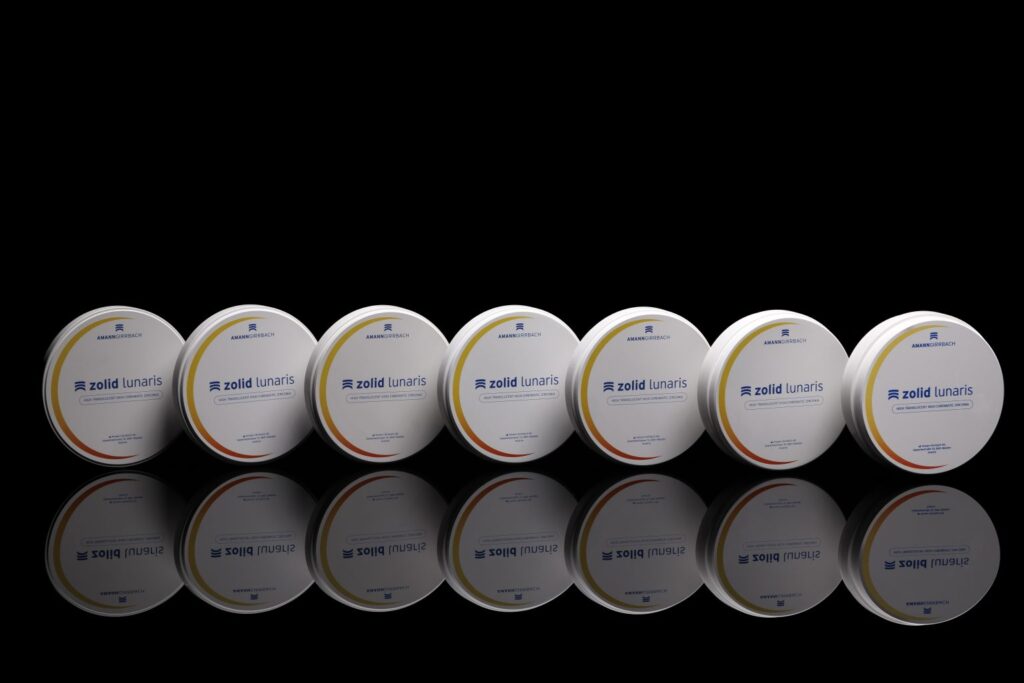
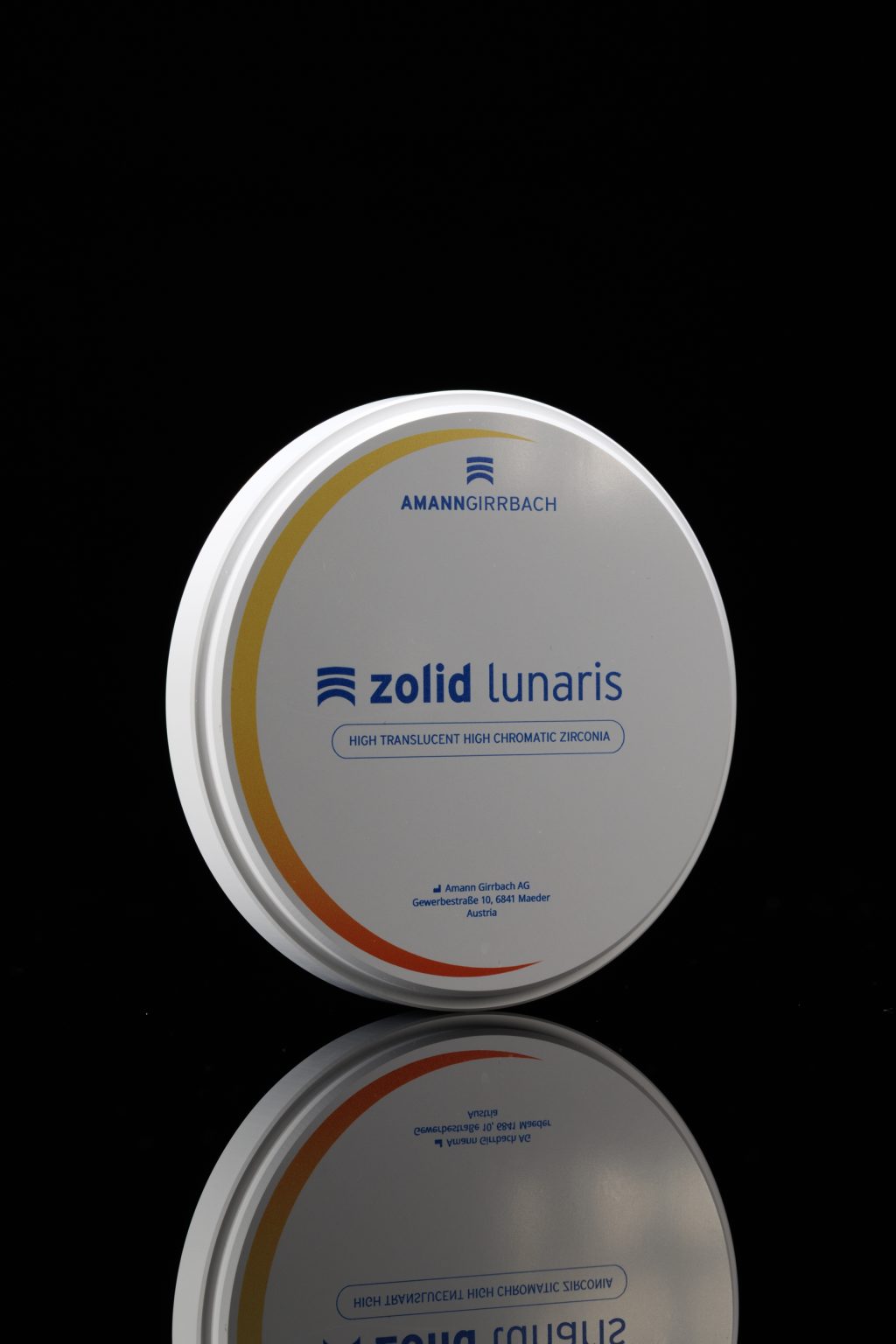
The company Amann Girrbach, a pioneer in dental CAD/CAM technologies, has announced the launch of Zolid Lunaris—the latest material in the Zolid zirconia lineup. The development focuses on stability, reproducibility, and efficiency, and also reflects current market trends aimed at simplifying workflows and minimizing finishing steps.
The concept of Zolid Lunaris: stability and color accuracy
Much like the Moon, symbolizing constancy and reliability, Zolid Lunaris embodies these qualities in a material with enhanced chromatic properties. Improved color saturation simplifies finishing, reduces the number of labor-intensive manual steps, and ensures precise matching to VITA shade guide shades. As a result, laboratory technicians achieve a more predictable and reproducible aesthetic outcome with less time investment.
The material is a multi-layer zirconia with intense and saturated shades in the A–D range. It possesses a strength of approximately 1000 MPa, making it a versatile solution for all types of fixed prosthetic restorations. A significant advantage is its capability for high-speed sintering: restorations can be fully sintered in just 15 minutes, significantly accelerating the production cycle. The Zolid Lunaris portfolio includes blanks with heights ranging from 12 to 30 mm, 14 classic A–D shades, and five bleached shades, with the material being manufactured in Austria and meeting the traditionally high-quality standards of Amann Girrbach. Within the Zolid lineup, it is clearly positioned as the “workhorse,” complementing the more aesthetically oriented Zolid Bion.
Expert evaluations and product positioning
According to Melanie Röschmann, Senior Product Manager in the consumables category, customer requirements are constantly evolving, which drives continuous product refinement. She notes that Zolid Lunaris sets a new benchmark with its enhanced coloration, enabling the reduction of workflow steps while achieving precise matching to VITA shades. As the successor to Zolid Gen-X, the material combines premium quality with high economic attractiveness.
Axel Reichert, Senior Manager of Materials Research and Development, emphasizes that Zolid Lunaris takes the concept of high-speed sintering to a new level. Crowns and three-unit bridge restorations can be sintered in 15 minutes in the Therm DRS furnace without compromising the material’s mechanical properties. This approach makes the workflow not only simpler but also more cost-effective.
Advantages of milling and sintering
Zolid Lunaris was developed by dental experts for dental professionals, ensuring its seamless integration into both laboratory and clinical workflows. The balanced density of the material’s “white body” facilitates precise milling, reduces tool wear, and enables the creation of thin and clean marginal zones. The individually calculated shrinkage coefficient ensures optimal restoration fit, especially when using Motion Air systems.
Sintering processes are based on specially designed programs that enable the production of restorations in VITA shades with a strength of up to 1000 MPa, combining a natural appearance, durability, and aesthetics. The capability for high-speed sintering in 15 minutes without compromising quality is one of the key factors enhancing productivity. Blanks with a diameter of 98 mm are compatible with most common milling machines, supporting the flexibility and efficiency of digital workflows.
The efficacy of Zolid Lunaris has been confirmed by independent dental laboratories and clinics that participated in testing the material. Alen Sacru from Zirconnet Laboratory in Bucharest noted the impressive combination of high aesthetics and strength, describing the material as a truly convincing product. Giuseppe and Alessia Umile from Laboratorio Dentek in Santa Ninfa (Italy) referred to Zolid Lunaris as a “quantum leap in color accuracy,” emphasizing its enhanced cervical chroma and precise incisal match to the VITA scale.
Conclusion
Zolid Lunaris combines high strength, enhanced aesthetic characteristics, and optimized workflows, setting a new standard within the Zolid family of zirconia materials. Its introduction reflects the overall direction of development in dental prosthetics — a pursuit of predictability, efficiency, and reduced fabrication time without sacrificing quality. Thanks to this, the material represents a promising solution for laboratories and clinics focused on modern digital technologies and high clinical-aesthetic demands.
Modern dentistry is developing under conditions of rapid growth in clinical capabilities. New materials, digital technologies, imaging methods, and treatment
The global dental industry is undergoing an intensive digital and technological transformation requiring new cooperation between clinical, industrial and educational
We use cookies to improve website performance, analyze traffic, and personalize content. You can accept all cookies or customize their use. Learn more in our Cookie Policy.
Functional
Always active
Technical storage or access is strictly necessary for the legitimate purpose of making possible the use of a particular service expressly requested by the subscriber or user, or solely for the purpose of carrying out the transmission of a message over an electronic communications network.
Preferences
The technical storage or access is necessary for the legitimate purpose of storing preferences that are not requested by the subscriber or user.
Statistics
Technical storage or access used solely for statistical purposes.The technical storage or access that is used exclusively for anonymous statistical purposes. Without a subpoena, voluntary compliance on the part of your Internet Service Provider, or additional records from a third party, information stored or retrieved for this purpose alone cannot usually be used to identify you.
Marketing
Technical storage or access is necessary to create user profiles for the purpose of sending advertising or to track a user across a website or multiple websites for similar marketing purposes.