Main » New in Dentistry » From LITE to PRO: How to choose a VITA furnace control unit for a dental laboratory
From LITE to PRO: How to choose a VITA furnace control unit for a dental laboratory
Introduction
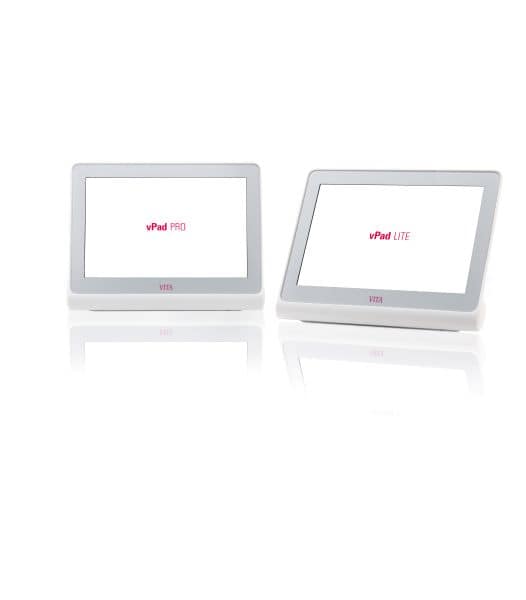
The company VITA Zahnfabrik has introduced two new control units for firing and sintering furnaces—the VITA vPad LITE and VITA vPad PRO, designed to replace the previous vPad comfort and vPad excellence models.
Both devices are focused on optimizing the daily workflow in dental laboratories and clinics through a simplified interface and expanded functional options; below is an analysis of the key differences and practical implications for clinical and laboratory work.
Key characteristics
VITA vPad LITE
VITA vPad LITE is designed for standard firing and sintering cycles, with a focus on intuitive navigation and a simplified menu, which reduces staff training time and minimizes the likelihood of mode selection errors.
VITA vPad PRO
VITA vPad PRO is oriented towards more complex workflows: the manufacturer indicates the presence of additional options, including a programmable start and expanded connectivity variants; this makes the device more convenient for shift planning and integration into the laboratory’s digital environment.
Methodology and design solutions
The development involved creating two versions of the control unit with different sets of functions and interface solutions to ensure compatibility with existing VITA firing/sintering furnaces.
Interface: simplified navigation in LITE and a more functional menu in PRO for fine-tuning programs.
Scheduling: The PRO version implements an option for a programmable start, which allows cycles to be launched at a pre-set time and optimizes equipment usage during off-peak hours.
Connectivity: The manufacturer announces expanded connectivity options; when purchasing, it is recommended to clarify the specific interfaces and protocols to ensure compatibility with the laboratory’s LIS/software.
Results and expected effect
According to the information presented, the new control units provide more intuitive navigation and a range of functional options that potentially contribute to reducing the time required for maintaining firing and sintering cycles.
Reduction of operational delays due to the simplified interface and the ability to program starts in the PRO version.
Improvement in procedure reproducibility through correct transfer and storage of firing/sintering programs.
Improvement in workplace ergonomics and reduction in technical staff training time.
Relevance for clinical practice and laboratories
The choice between versions depends on the volume and complexity of technological processes: for typical tasks of restorative ceramics and standard sintering regimes, the LITE version is sufficient, whereas PRO is advantageous when flexible shift scheduling, integration with digital systems, and managing a large fleet of furnaces are required.
For the dentist and technician, it is important to consider that the actual improvement in productivity and quality will depend not only on the functionality of the control unit, but also on the standardization of firing protocols, staff qualifications, and the overall organization of the process in the laboratory.
Expert commentary
When assessing the feasibility of replacing or acquiring a new control unit, it is recommended to pay attention to the following aspects:
Compatibility of existing firing/sintering programs with the new interfaces and the possibility of their transfer or re-validation.
The presence and format of cycle logging to ensure traceability and validation of technological processes.
Requirements for integration with laboratory software and network infrastructure—clarify specific interfaces and protocols with the supplier before purchase.
Evaluate the impact on shift logistics and furnace loading: the programmable start function can increase throughput with proper shift organization.
Practical recommendation
For clinics and laboratories with predominantly standard regimens and limited integration requirements, the VITA vPad LITE may be the optimal choice; for large laboratories and digital complexes where cycle scheduling and integration are important—the VITA vPad PRO.
Pilot testing at a single workstation, validation of key firing/sintering programs, and comparison of actual time savings and result stability are recommended before full-scale implementation.
Additional information
Sales start date: the devices are available from October 20, 2025.
The World Health Organization supports strengthened cooperation between health and environmental control authorities to accelerate the phase-out of dental amalgam
We use cookies to improve website performance, analyze traffic, and personalize content. You can accept all cookies or customize their use. Learn more in our Cookie Policy.
Functional
Always active
Technical storage or access is strictly necessary for the legitimate purpose of making possible the use of a particular service expressly requested by the subscriber or user, or solely for the purpose of carrying out the transmission of a message over an electronic communications network.
Preferences
The technical storage or access is necessary for the legitimate purpose of storing preferences that are not requested by the subscriber or user.
Statistics
Technical storage or access used solely for statistical purposes.The technical storage or access that is used exclusively for anonymous statistical purposes. Without a subpoena, voluntary compliance on the part of your Internet Service Provider, or additional records from a third party, information stored or retrieved for this purpose alone cannot usually be used to identify you.
Marketing
Technical storage or access is necessary to create user profiles for the purpose of sending advertising or to track a user across a website or multiple websites for similar marketing purposes.